
Every superintendent you interview this year has already answered your best question. "Tell me about a time you handled a conflict with a sub" has been asked of them a dozen times, and the story they tell you is the one that worked the last eleven times. That answer measures how well they interview, not how well they run work.
A scenario interview closes that gap, but only if the leader builds it deliberately. Leaders who can't see themselves clearly can't see candidates clearly, and the interview is where a leader's judgment becomes visible. The fix isn't better candidates: it's better leaders who own the process, and owning the process starts with designing the interview itself. A well-built scenario puts a candidate in deep water and lets you watch them think instead of recite.
The edge of the rehearsed self
Every candidate arrives with a prepared surface: polished stories, safe opinions, a resume they can narrate in their sleep. Standard interviews never leave that surface. The questions are predictable, so the answers are prefabricated, and prefabricated answers correlate with interview skill, not job skill.
Deep water starts where preparation ends. When a candidate faces a situation they could not have rehearsed, with a clock running, the prepared surface gives out and you see the defaults underneath: how they triage, what they say when they don't know, whether they own a problem or talk around it.
You cannot get there by asking harder questions. Hypotheticals ("what would you do if...") still get hypothetical answers, which is why real-world problems beat experience assumptions. You get there by building a world and putting the candidate in it.
What a scenario interview looks like
Here is the shape of one I use for superintendent hires, adapted for each client and project.
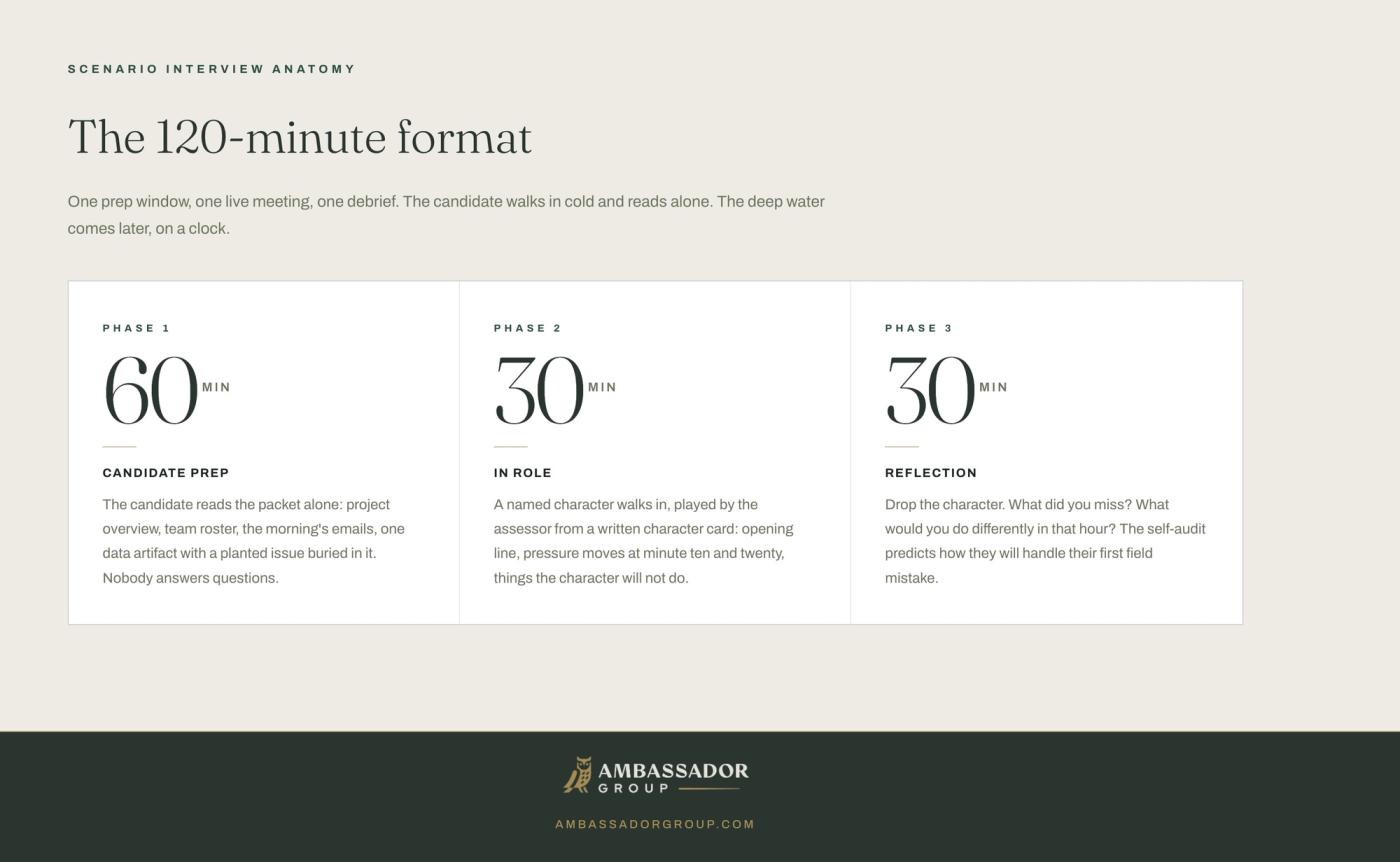
The candidate arrives and receives a packet: they are three days into the job as superintendent on a mid-rise, taking over from a super who left abruptly. The packet holds the project overview, a team roster, a status table, the morning's emails, and an RFI log. They get sixty minutes alone with it. At the sixty-minute mark, a steel foreman with thirty years in the trade walks in for a meeting the candidate knows is coming. Tomorrow there is a crane pick.
Buried in the materials is a problem: an RFI about a revised header detail was approved by the architect and marked closed in the project software, but the revision was never executed in the field. The paperwork says one thing. The building says another. A careful reader can triangulate it from the RFI log and one line in an email. Nobody announces it.
Now watch what happens. One candidate walks in and works the foreman with war stories. Another hedges every answer toward "I would check with the PM." A third says, in so many words: the log shows this closed three weeks ago, but closed in the software is not the same as executed in the field, and until someone walks that header, tomorrow's pick is not confirmed. Same packet, same hour, three different superintendents. No behavioral question would have separated them.
Five design principles for deep water
The scenario above is not a lucky script. It is engineered, and the engineering follows principles any hiring leader can apply.
Put them early in the job, not outside it
Day two to day ten of employment is the honest setting: the candidate has ownership but not knowledge. That is the exact position where leaders get tested on live jobs, and it removes the escape hatch of "I would need more context." Limited context is the test.
Give the morning a forcing function
A specific meeting with a specific person at a specific time. A bid due in 48 hours. A 10:00 owner call. Open-ended scenarios produce open-ended musing; a clock produces decisions, and decisions are what you came to see.
Plant issues that interact
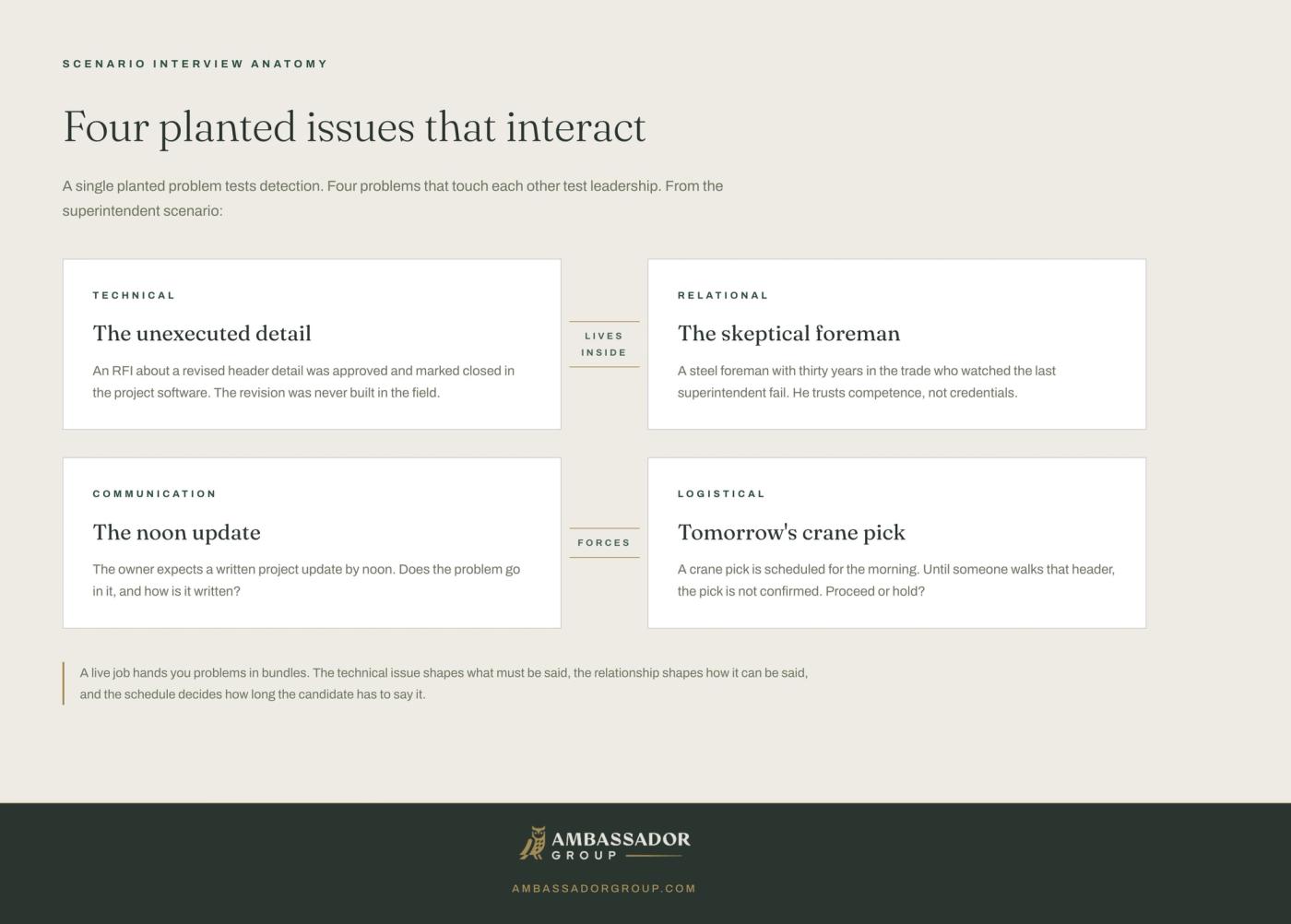
A single planted problem tests detection. Four problems that touch each other test leadership. In the scenario above, the technical issue (the unexecuted detail) lives inside a relational issue (a skeptical foreman who watched the last super fail), which shapes a communication issue (the owner expects a written update by noon), which forces a logistical call (does tomorrow's pick proceed). A live job hands you problems in bundles. Your assessment should too.
Play a person, not a panel
The candidate should meet a character with wants, history, and a temperament, played by an assessor working from a written character card: opening line, pressure moves at minute ten and minute twenty, things the character will not do. A skeptical foreman who lets silences sit teaches you more about a candidate in five minutes than a conference table of smiling interviewers learns in an hour.
Make missing it informative too
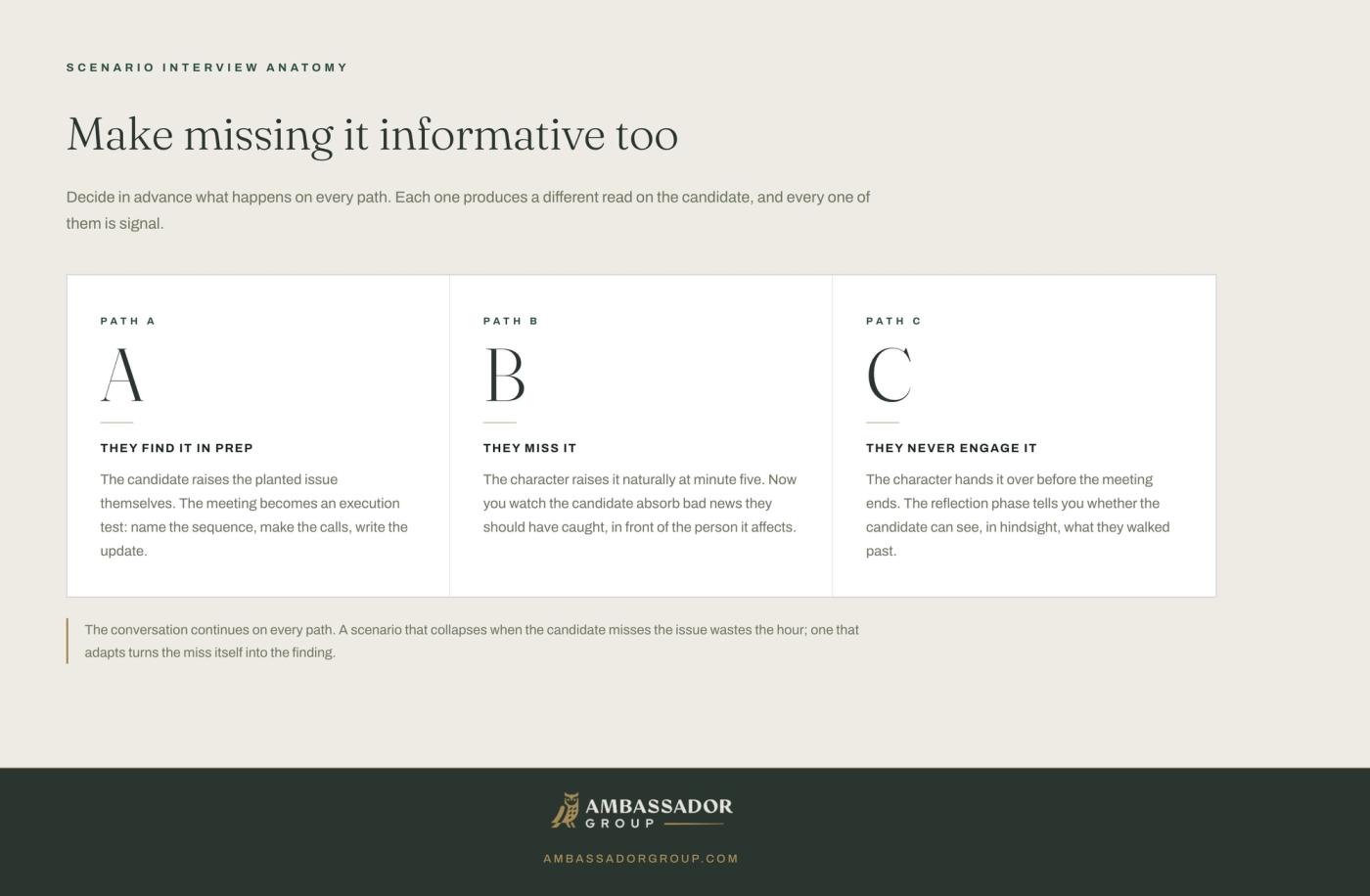
Decide in advance what happens on every path. If the candidate finds the issue in prep, the meeting becomes an execution test. If they miss it, the character raises it naturally at minute five, and now you watch them absorb bad news they should have caught. Either way you learn something true about the candidate, and either way the conversation continues instead of collapsing.
The follow-ups are the deep end
Surfacing the planted issue is the midpoint, not the finish. The deepest water is the sequence of follow-ups that runs past the candidate's last prepared thought: What do you do in the next thirty minutes? Who do you call first, and what do you say? The owner needs a written update by noon. Does this go in it, and how do you write it? If the mistake happened three weeks ago on someone else's watch, why does the fault matter less than the fix?
Each question forces a commitment. Strong candidates name a sequence out loud and defend it. Weak candidates fill silence, hedge in probabilities, or reach for whose fault it was. You are no longer evaluating an answer. You are watching someone run a job.
Then close with reflection, because the reflection shows you what a candidate does with their own mistakes minutes after making them. After the role-play ends, drop the character and ask: What did you miss? What would you do differently in that hour? Where did you feel yourself reaching? A candidate who can audit their own performance will audit it on your project too. A candidate who reports a flawless hour has told you how they will handle their first field mistake.
Build one this month
You do not need software or a consultant to start. Pick a project you know intimately, ideally one with a problem you lived through. Write the packet a candidate would read cold: the situation, the roster, the morning's emails, one data artifact with the issue buried in it. Write the assessor's character card and the follow-up questions before anyone interviews, and decide what strong and weak look like for each competency in advance, so you are grading against a standard instead of a mood. Then run it: sixty minutes of prep, thirty in role, thirty in reflection.
Tell candidates the format in advance. There is no trick here: the strongest candidates prefer showing their work to selling it, and a scenario respects them more than a pop quiz ever will. Write it once and run every finalist through the same hour; identical water is what makes the comparison honest.
Two hours is a serious investment. So is a mis-hire who interviewed beautifully. The candidates who impress you in deep water are rarely the ones with the smoothest stories.
The next interview you run can measure rehearsal or it can measure thinking. You own the design, so you already own the choice.


