
Everything a candidate hands you has been rehearsed. The resume went through six drafts, the interview answers were practiced in the car, and the references were chosen because they would say the right things. None of that makes the candidate dishonest. It makes them human. But it leaves you underwriting a six-figure decision on polished evidence, and polish hides exactly what you need to see. The sentence completion exercise is a tool for getting underneath it: thirty unfinished sentences, completed fast, that show you how a person thinks when they haven't had time to decide how they want to appear.
The gap it closes is a leadership problem before it is a candidate problem. Leaders who can't see themselves clearly can't see candidates clearly, and a leader who has never examined their own response to failure will read a candidate's answer about failure as trivia instead of signal. This tool only works in the hands of someone willing to point it at themselves first. More on that below.
What the sentence completion exercise is
The instrument is simple. You give the candidate thirty sentence stems and ask them to finish each one quickly, in writing, without overthinking. The stems are short and open:
- I am proudest of:
- When I fail:
- When I disagree with someone at work:
- When criticized I:
- Company politics is:
- When I don't get results:
- Controlling my emotions is:
- My real ambition is:
The instructions matter as much as the stems. Short answers. Move fast. Don't overthink. Speed is the point: a candidate who has twenty seconds per stem gives you their first-order response, the one that runs their behavior on a Tuesday afternoon under deadline pressure. A candidate with a week and a thesaurus gives you their brand.
It makes no claim to validated psychometrics. Think of it as a core sample. A geotech crew doesn't pull a core to pass judgment on the dirt; they pull it to learn what the ground will carry before anyone pours a footing.
What the stems surface
Interviews are good at surfacing competence and bad at surfacing disposition. A superintendent can walk you through a schedule recovery in convincing detail and still be someone who goes quiet for three days after criticism. The stems aim directly at disposition, and they cluster around the things that sink hires after the honeymoon:
Ownership
"When I don't get results:" is the sharpest stem on the list. Watch where the sentence goes. "I figure out what I missed" and "the goalposts usually moved" describe two different employees, and both people will interview well.
Failure and criticism
"When I fail:" and "When criticized I:" reveal whether a person metabolizes hard feedback or merely survives it. An answer like "I take a day, then I want the details" is a gift. So is "I usually think the criticism says more about the critic," in the other direction.
Conflict
"When I disagree with the majority:" and "When there is conflict I:" tell you whether you are hiring someone who will voice the dissent your team needs or swallow it until it curdles.
Motive
"My real ambition is:" and "Success means:" show you what the person is aiming their career at. If their answer contains nothing your company can offer, no interview charm changes that math.
No single answer means much. A pattern across thirty answers means a great deal.
How to read the responses
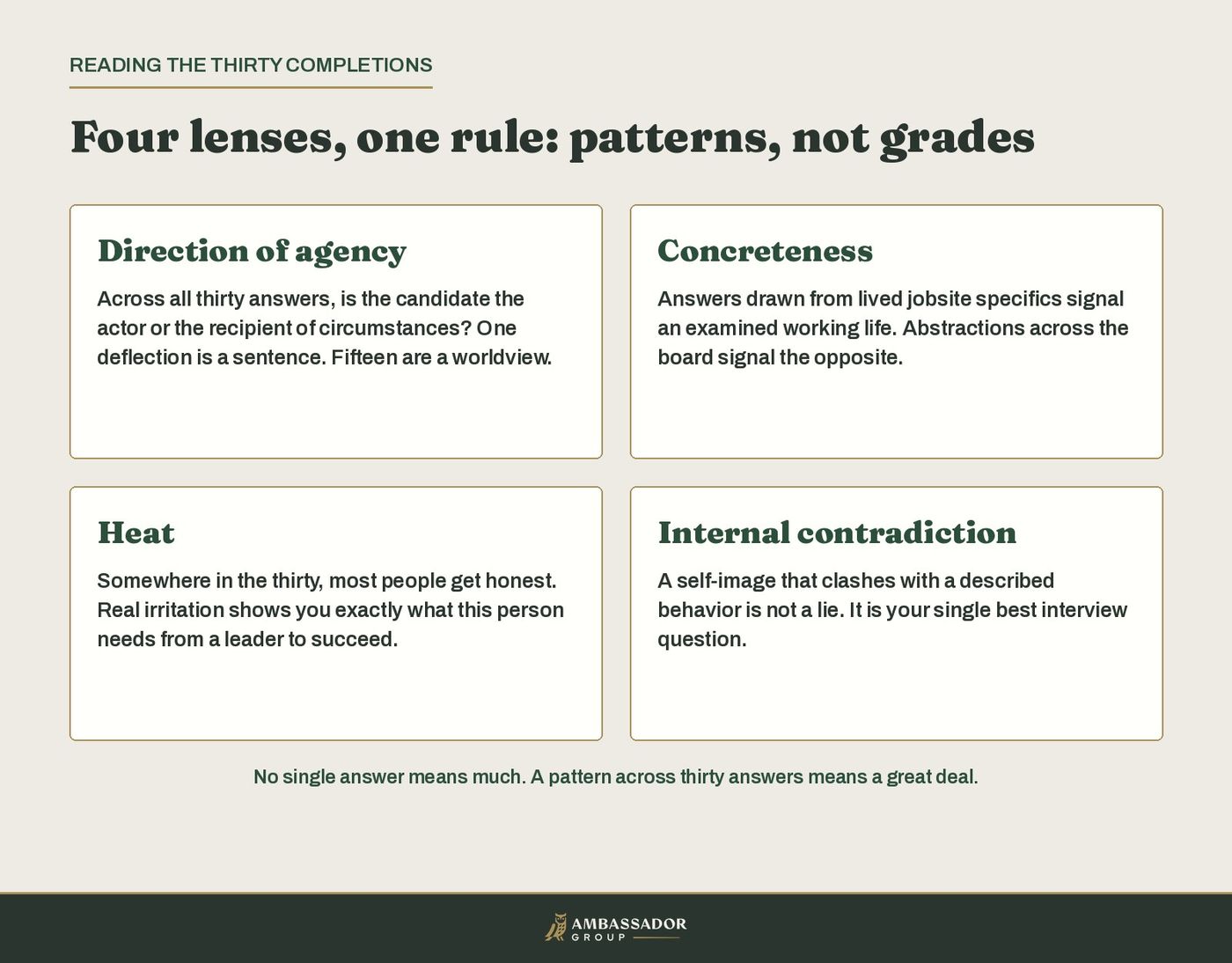
Reading the responses is where most companies fumble the tool, because the temptation is to grade them. Resist that. You are underwriting a risk, not scoring a quiz, and an underwriter's job is investigation. Watch four things:
Direction of agency
Across all thirty answers, count how often the candidate is the actor in their own sentences versus the recipient of circumstances. One deflection is a sentence. Fifteen is a worldview.
Concreteness
"Integrity is: doing what you said on the change order nobody will ever audit" comes from lived experience. "Integrity is: very important" comes from nowhere. Abstract answers across the board suggest a person who hasn't examined their own working life, which matters if you are hiring them to examine anyone else's.
Heat
Somewhere in the thirty, most people get honest. "I get annoyed when:" and "Company politics is:" carry heat, and heat is information. A flash of real irritation about vague direction, credit-taking, or being micromanaged tells you precisely what this person needs from you to succeed.
Internal contradiction
"Colleagues think I am: direct" sitting next to "When there is conflict I: avoid it until it's necessary" isn't a lie. It's the outline of a person who hasn't reconciled their self-image with their behavior, and it is the single best interview question the exercise will hand you.
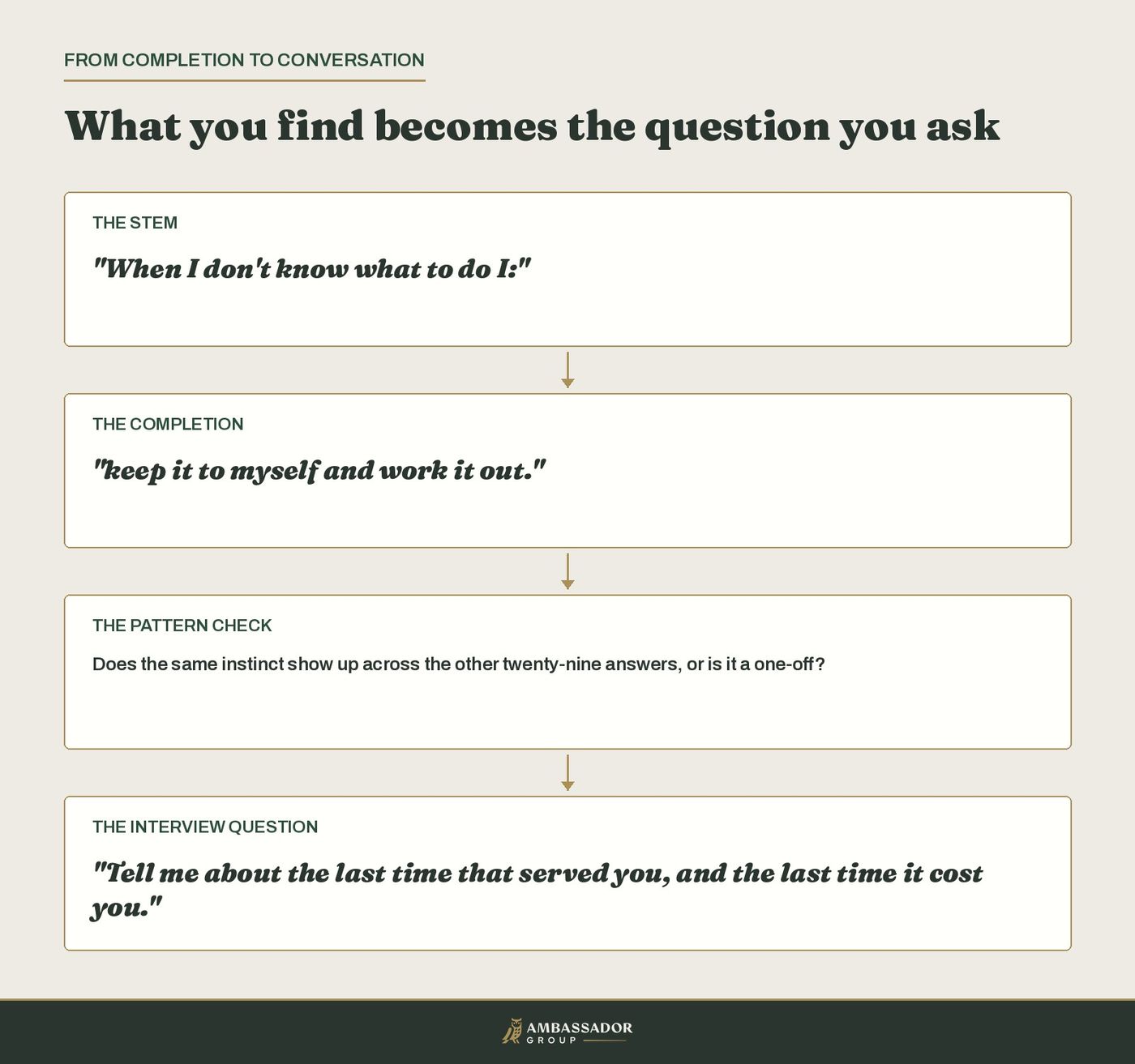
Everything you find goes one place: into the interview, as a question. "You wrote that when you don't know what to do, you keep it to yourself and work it out. Tell me about the last time that served you, and the last time it cost you." Candidates open up when you ask about what they wrote, because you are quoting them to themselves. It is the rare interview question that cannot be answered with a canned story.
Running it without wrecking trust
The exercise reads people at close range, so it obligates you to handle it with care. Three rules keep it honest.
Tell the candidate what it is and what it isn't. "This helps us get to know how you think. There are no right answers, and nobody passes or fails it." Then honor that framing: the day a candidate learns they were screened out over one sentence is the day your hiring process becomes a story other candidates hear.
Place it mid-process, not at the gate. Asking for this level of candor before you have earned any trust gets you either guarded answers or resentment. After a first conversation, it reads as interest. Before one, it reads as surveillance.
And complete it yourself before you ever send it to a candidate. Sit with "When criticized I:" and "When I don't get results:" and write your own honest endings. If the answers make you flinch, you have found the reason this tool works, and you have learned something about the person doing the hiring. You cannot read agency, candor, and self-awareness in someone else's sentences if you have never checked for them in your own.
A hire is one of the largest unsecured risks a construction company takes on. The sentence completion exercise will not eliminate that risk, and it renders no verdicts. What it does is show you what the ground is made of before you pour.
You already know which sentence you'd hesitate to finish honestly. Start there.
The short version.
- What is the sentence completion exercise in hiring?
- A written exercise with thirty unfinished sentence stems. The candidate finishes each one quickly, in about twenty seconds, without overthinking. The speed produces first-order responses instead of rehearsed answers, which shows how the person thinks about failure, criticism, conflict, and ownership.
- Is the sentence completion exercise a personality test?
- No. It makes no claim to validated psychometrics. Treat it like a core sample: it surfaces patterns worth investigating in the interview, and it should never be used as a pass or fail screen.
- How should employers read sentence completion answers?
- Look for patterns across all thirty answers rather than judging single responses. Watch four things: direction of agency, concreteness, emotional heat, and internal contradictions. Turn what you find into interview questions instead of verdicts.
- When in the hiring process should a candidate complete it?
- Mid-process, after a first conversation has built some trust. Sent before any relationship exists, it reads as surveillance and produces guarded answers. Tell the candidate plainly that there are no right answers and nobody passes or fails it.


