
"Culture fit" gets used in hiring meetings the way duct tape gets used on a jobsite: stuck onto everything until it holds nothing. Ask the leader who just said it what it means and the answer goes soft fast. Someone you would grab a beer with. Someone who does not cause friction. Someone who feels right.
That vagueness is expensive, and the cost lands on the leader before it lands on anyone else. Culture is what your company does when doing the right thing costs money, time, status, or comfort. If you cannot say what that is in plain sentences, you cannot interview for it, and the word "fit" fills the gap with whatever the people in the interview happen to like. The read on the candidate is only as sharp as your read on your own standards.
This article covers the whole job: what culture is, how to see the one you already have, how to put the few non-negotiable beliefs on paper, and how to screen for character without screening for sameness. It sits upstream of every chapter in Hire in 4K. You can run a disciplined interview process against a culture you never defined, and you will still be guessing about the thing that decides whether a hire lasts.
Culture is what you do when it costs you something
The word comes from the Latin colere, to tend or to cultivate. Culture is what gets tended over time: the habits, decisions, rewards, and stories a company reinforces until they become the default. Seth Godin compressed it into one line that holds up well on a jobsite: "People like us do things like this."
Two things follow from that definition.
First, you already have a culture. It may be undefined, inconsistent, or not the one you would choose, but something is being reinforced every week. The only question is whether you are tending the culture you want or letting one grow by default.
Second, culture shows up at the edges. It is invisible on a calm Tuesday and obvious the week a job goes sideways: when a deadline slips, when a client changes scope midstream, when one crew has to clean up another crew's mess. A company's values are whatever it does in those moments, no matter what the handbook says.
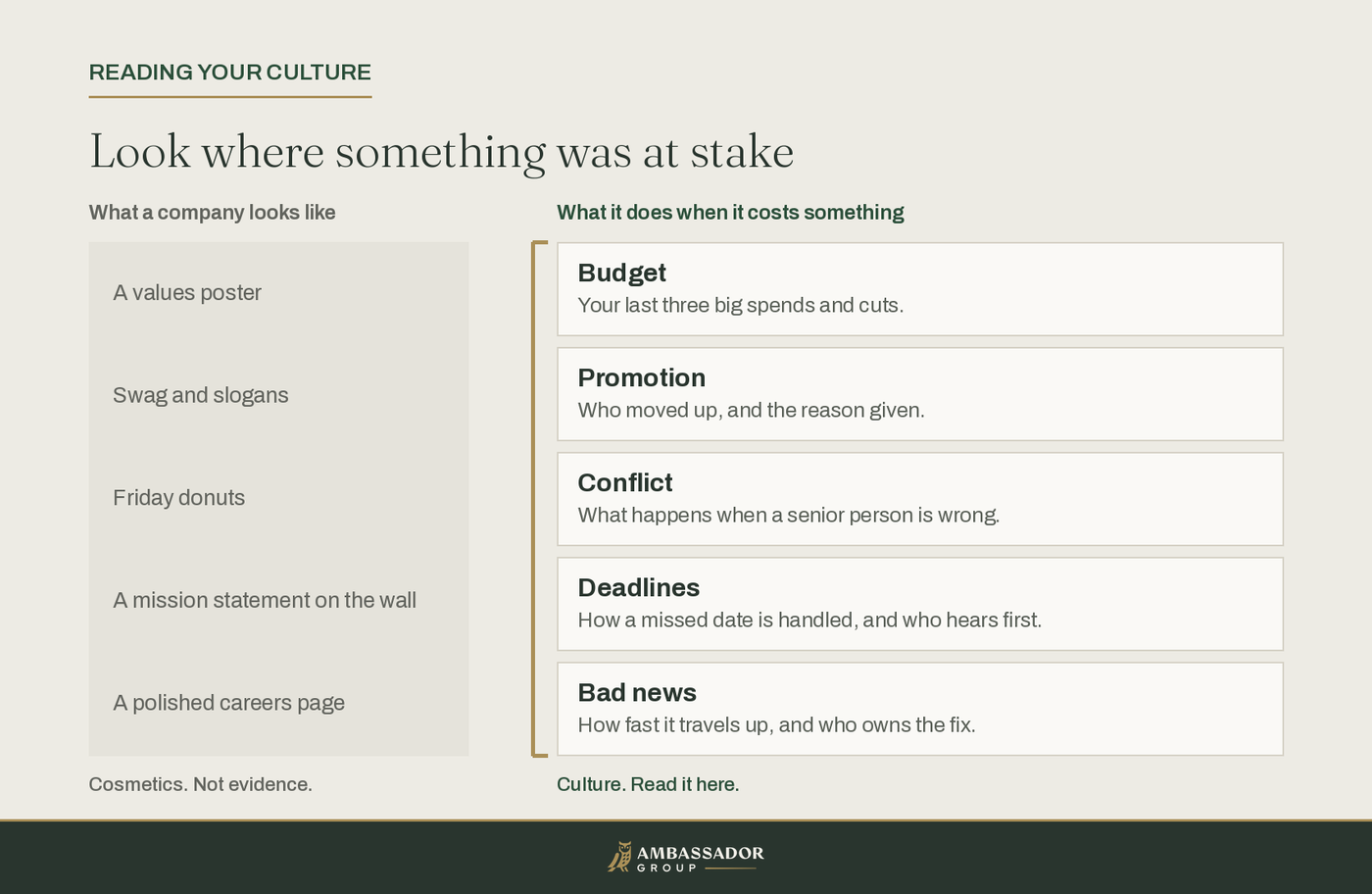
That gives you a working test for anything that claims to be culture. Slogans, swag, a values slide, Friday donuts, and a mission statement on the conference room wall are cosmetics. They show what a company looks like. Culture is what the company does when a decision costs something. If you claim to value safety and a superintendent takes a shortcut to make a date, the shortcut is the culture. If you preach craftsmanship and reward speed, speed is the culture.
Cosmetics do harm when they substitute for the real thing, and they substitute for it constantly, because a leader can buy hoodies by Friday and cannot buy trust at any price.
Company personality is not company culture
People often confuse a company's culture with its personality. Every company has a temperament, a composite of the people in it and above all of its leaders. Some companies are introverted and some are loud. Some are playful, some are serious, some run on banter and some on quiet focus. That temperament is real, and it is often the first thing a candidate notices. It may or may not reflect what the company believes. A serious shop can bury defects, and a goofy one can hold the line on safety every time. Read the beliefs from what happens when something is at stake, which is what the five tests below are for.
Charm works the same way in a company as in a person. A warm, fun, generous-feeling workplace is no more proof of kindness than a charming candidate is proof of character. Some charming people are kind. Some are manipulative, and the charm is how they get away with it. Judge both by what they do when kindness costs them something.
Five tests that show the culture you have
Start by observing what happened. Five tests tell you a lot about a company's culture, because each one asks what happened when something was at stake.
- Budget. Look at the last three big spends and the last three cuts. That is your culture in dollars.
- Promotion. Who moved up in the last two years, and why? The handbook's answer and the real answer often differ.
- Conflict. What happens to dissent when a senior person is wrong?
- Deadlines. When a date slips, how is the miss handled, and who hears first?
- Bad news. How fast does it travel up, how clearly, and who owns the correction?
Three questions add the people side. Who thrives here and stays? What gets celebrated? What gets tolerated? The last one matters most. Culture is as much what you allow as what you encourage, and the behavior you tolerate from a high producer is the standard the rest of the team reads.
Then run a simple check. Ask three to five employees to describe the culture in one sentence. If they all say something different, the culture lives in your head and nowhere else. Leaders have a hard time judging their own culture, partly because they are inside it, like fish in water, and partly because what they intend and what employees experience can drift apart without anyone saying so out loud.
When you write down what you find, your current team should read it and say, "Yes, that is us." If they do not, you have a gap between the culture you have and the culture you want. Both matter, and they need different handling. Hiring people to an aspiration you have not built yet frustrates them and confuses the team they join. Own where you are, name where you are headed, and be honest with candidates about the distance between the two.
Why leaders settle for cosmetics
Leaders drift into theater, pushed there by a handful of forces, and many run several at once.
What photographs well gets credit. Office design and a polished careers page are visible to outsiders. Decision rights, written standards, and honest postmortems are not. If your company looks great on social media and has almost no written record of what it learned from its last three bad jobs, this force is winning.
Cosmetics are controllable. Merch, events, and campaigns can be scheduled and carry no conflict. Real standards create losers and noise. If the culture budget goes to swag while manager training and escalation paths go unfunded, you are buying theater.
Optics pay off this week; behavior compounds next quarter. That is why culture initiatives launch every six weeks and stall. Freeze the slogans until you can show two behavior metrics moving and name who moved them.
Real standards require confrontation. The classic failure is the high producer who breaks the guardrails and keeps winning revenue. Count the documented value violations and the consequences applied last quarter. A count of zero usually means the standards went unenforced, not that no one broke them.
A critique of the culture feels like a critique of the founder. So a rebrand replaces the harder conversation, and the company orbits the limits of its leader's self-awareness.
Growth outruns the systems. Headcount arrives before definitions of done and decision rights do, and rituals multiply to paper over the cracks.
Sincere mistakes and the tropes that do damage
Cosmetics are what leaders reach for when building standards feels too slow. The beliefs below come from leaders who mean well, which makes them harder to spot and slower to correct. Each one sounds reasonable in a leadership meeting, and each one bends the company in ways leadership doesn’t understand.
Mistakes made in good faith
"We all know what we stand for." Long-tenured teams believe this because the beliefs feel obvious to the people who formed them. Run the one-sentence check from the five tests on your interviewers. When their answers differ, each one is screening against a private version of the standard, and new hires are left to guess.
"Silence means agreement." Tenure and quiet get read as buy-in. A superintendent who has stopped arguing may have stopped caring, and the leader finds out which when that superintendent resigns or a shortcut surfaces on a job. Agreement shows in what people do when the standard costs them something, the same evidence the five tests ask for.
"A healthy culture has no conflict." Leaders who prize harmony start hiring for it. Agreeable candidates interview well, the person who pushes back on a bad sequence reads as abrasive, and over a few years the team loses the people who would have raised the problem early. Screen for how a candidate disagrees, and leave room for disagreement in the answer you score.
"Hire for attitude, train for skill." Half of this holds: belief is harder to change after the hire than skill. The damage comes when "attitude" stays undefined and turns into enthusiasm in the interview, which favors the confident and the familiar. Name the behaviors you mean by attitude, score them, and still verify the skill the job needs on day one.
"Culture belongs to HR." In a company this size that often means the office manager. Either one can run the process. Neither can set the standard, and neither can enforce one on the leader's own direct reports. Delegated culture turns into programs and surveys, and the crew reads the gap between the program and what their manager rewards.
"Copy what the big companies do." A bonus plan lifted from a larger GC, or a perk lifted from a tech firm, imports the cost without the conditions that made it work: their project mix, their margins, their job cycle. Before copying a practice, name the principle you admire and translate it to your own numbers. If you cannot do that, skip it.
Phrases that do damage
These show up in job posts, all-hands meetings, and interview debriefs. A candidate hears something in each one that the leader did not intend to say.
"We are a family." I hear this sentence in small construction companies over and over: "We are more than a team, we are a family." It sounds warm, and it misleads. Families are unconditional. Employment is not. When performance drops or the backlog dries up, the loyalty the metaphor promised does not come back, and people who overextended themselves on the strength of that promise feel it. The language also blurs boundaries healthy teams need: logging off, saying no, raising hard feedback.
A professional relationship built on mutual value can be warm, supportive, and loyal, and a slogan will not carry that any better than the family line did. Describe what you do: "You get written feedback every quarter, and if backlog threatens your hours, you hear it from me first." That kind of plain description is how a company treats people as people, not inventory.

"Work hard, play hard." To a candidate with kids, a second job, or no interest in the bar after the pour, this reads as long hours plus a social obligation. It can screen out steady people who keep their commitments and go home, and it rewards presence over output. If the job runs long in certain phases, say which phases and how the company makes up for it.
"We only hire A players." The phrase credits the person who rescued the job over the crew that kept it from needing a rescue, and it invites candidates who perform confidence. Construction runs on handoffs: estimating to operations, superintendent to subs, field to office. Say which results the role owns and how the team shares the rest.
"Our door is always open." An open door asks the person with the least power to walk in with bad news about someone with more. Bad news travels on paths built for it: a named escalation route that goes around the chain of command, and a record showing the people who used it faced no retaliation. If you have that path, describe it to candidates. If you do not, the open door is decoration.
Run every phrase your company uses through the cost test from the first section: what does the company do when living up to the phrase costs something? If the behavior falls short of the words, change the behavior or retire the words.
Belief at the center, difference at the edges
Under the behavior sits belief. In my work recruiting leaders for construction companies, the ones that hold their shape under pressure share one trait: a mission that governs decisions. Call that a mission operating system. Mission language that only decorates a website is theater.
The structure is simple to state and hard to build:
- Agreement at the center. Why the company exists, and what it will not do, is settled.
- Autonomy at the edges. How the work gets done is debated and improved constantly.
- A no-compromise test. If a tradeoff violates the center, the company does not make it.
Diversity belongs at the edges, and plenty of it. A strong team needs big-picture thinkers and detail-driven executors, people who invent and people who organize, a superintendent, a CFO, and a preconstruction lead who see the same problem three different ways. What it cannot have is three different centers. When teams hold different reasons for being, the company runs multiple playbooks and every hard call fractures along a different seam. Diversity without unity produces culture wars, low trust, and decisions no one can settle. Unity without diversity produces a team that agrees its way into stagnation. You need both, in their proper places.
When the center is missing, something else draws the line. Money draws it, or a threat of litigation, or political weight, or the loudest voice in the meeting. That is how a company loses weekends to rework, loses a client over a one-day delay, and still wonders why trust evaporated. Profit matters. It is fuel: necessary to run, and a poor reason to exist. A company that treats it as the reason for existing tends to treat employees as interchangeable means to that end, and employees return the favor by treating the company as a paycheck they will leave for a better one.
A center that works looks like this. Friday, 4:45 p.m. The inspector fails the stair rail and the owner walk is Monday. One voice says gloss it and punch it later. The superintendent points to the standards posted at the gang box: stop, fix it now, and call the client to preview the change. On Tuesday the owner thanks the team for naming it early. Theater would have hoped no one noticed. The operating system made the decision before the crisis arrived.
Short mission statements in construction can carry that kind of weight when each one names the tradeoff it accepts:
- A residential builder: build homes that endure in craft, comfort, and care for the neighbors. It accepts slowing or resequencing work to protect visible quality.
- A commercial interiors contractor: deliver day-one-ready spaces with no surprises. It accepts moving dates to surface scope gaps early.
- An owner's representative: protect the owner's intent through transparent, documented decisions. It accepts saying no to changes that compromise function, safety, or long-term cost.
The tradeoff is what makes each one a mission. Michael Porter's line applies here as much as to strategy: the essence is choosing what not to do.
Write it down, especially if you are small
For years I resisted writing down a mission, values, behavior expectations, and policies for my own company. The team was small. They knew how I operated. Why spend the hours?
That was the wrong question. The better one was how much pain I was willing to absorb from hires who did not work out. A large share of the hardest stretches in my business traced back to the time and rework of misaligned hires: the wasted search effort, the distraction, the morale hit, the awkward exits, and the work that could have been done better. When I went looking for the root cause, one of the biggest was that I had never been explicit about who the company is, how it works, and what it expects.
Writing it down did three things I did not expect.
It clarified my expectations of myself. In a small company the leader is the culture, and standards in black and white force the question of whether you live them. The team can see when you drift.
It gave the whole team a reference. New people got a shortcut to how things work and what success looks like. Existing people got a mirror. And hard conversations got easier, because the standard existed before the conversation did, which takes the personal sting out of it.
It sorted people. Clear expectations let people align themselves or opt out, and the documents attract the right candidates and repel the wrong ones before anyone spends a day interviewing. When culture is unspoken, people fill the gaps with their own defaults. Sometimes that works. Sometimes it is a disaster. Clarity is a way of saying here is the path, here is how it gets walked, and here is what good looks like, so people can succeed without guessing.
Small teams need this more than large ones, because every person's behavior has more impact.
The move from intuitive to intentional
Plenty of founders build their first culture without writing a word. It lived in how they shook hands, how they handled change orders, and how they decided when things went sideways. That intuitive culture was a real strength.
Growth breaks it. New people cannot read your mind. Middle managers interpret the unwritten rules differently, and onboarding turns into a game of telephone. What used to be obvious now needs translation, and without it the culture drifts or fractures. Needing structure is what growth looks like. The shift is something like moving from a campfire to a power grid.
The cost of waiting compounds. Here is a pattern I have seen more than once. A residential builder dominates its home market, then expands into several new markets in under two years. Recruiting is urgent, onboarding is rushed, and the standards never get translated for the new regions. Local leaders run their own playbooks, decisions that used to default to quality drift toward speed, and good hires struggle because there is no shared center to guide their tradeoffs. Finishes go inconsistent, rework spikes, owner walks get tense, and margin compresses. When the executives finally stop, the repair looks the same each time: a one-page creed, a handful of standards re-taught, authority in every region to stop the line, a market or two slowed to stabilize, and humane exits from the projects and senior roles that no longer fit. Quality starts to come back, slowly. The lesson is plain and costly: install the center before you scale, or you scale confusion.
Early installation costs hours and a few uncomfortable no's. Late installation costs margin, morale, and people, because misaligned wins become precedents, exceptions harden into policy, and the people who self-selected around the old center have to be unwound.
Turn each value into behavior you can see
A value you cannot test in a hiring process filters nothing. Values lists tend to fail right here: "integrity," "excellence," and "teamwork" describe nearly every company in the country and screen for nothing.
Keep the list short, three to five at most. A good rule for what makes the cut: you would lose a project over it. If you would not pay a price for a value, it is a preference.
Then translate each one into behavior. "We value accountability" is a poster. "Accountability here means you own your crew's mistakes, fix the problem before you look for whose fault it was, and update the client before they have to ask" is a standard someone can be hired, coached, and reviewed against.
For each value, write:
- Two observable behaviors. What someone living it does, in jobsite terms.
- One never. The behavior that violates it, stated plainly.
- One recent story. A real decision where the value cost the company time or money, and who owned the cost.
Three examples of what that produces:
- "We own our mistakes." Admits being wrong, takes corrective action without excuses. Never: lets a defect ride because the inspector missed it. Interview test: "Tell me about a mistake you made on a job. What happened, and what did you do in the next day?"
- "Quality over speed." Refuses to cut corners, takes pride in getting it right the first time. Never: buries a defect to make a date. Interview test: "You are behind schedule, and rushing will get you there at lower quality. What do you do?"
- "People over profit." Treats employees and clients as long-term relationships. Never: wins a deal by burning a trade partner. Interview test: "Have you ever walked away from work because it did not fit your values? What happened?"
The story bank matters more than it looks. Stories are how culture travels when you are not in the building, and they become interview material later. If you cannot name a recent story behind a value, you are only claiming it.
Two checks keep the list honest. First, could a reasonable person on your team use this value to veto a profitable decision without retaliation? If not, it is wallpaper. Second, does any metric you pay people on pull against it? If the superintendent's bonus rides on schedule alone, "quality over speed" loses every close call. Fix the metric.
Culture fit is a character question
Press on the phrase "culture fit" in the construction companies I work with and it collapses into three things: work ethic, respect for others, and humility. All three are worth hiring for, and all three are character. Work ethic is basic job readiness; respect and humility are emotional maturity. Filing them under culture waters them down, so call them character and screen for them by name.
By character I mean something narrower than being a good person: personally held standards about behavior under pressure. Integrity when the honest answer is expensive. Humility when the mistake is yours. Teachability when the correction comes from someone twenty years younger.
I have watched two people with nothing obvious in common decide in twenty minutes that they could work together, and two people who matched on paper grind against each other for a year. For a long time I filed that under chemistry. What I think now is that character is the part that transfers. Two people with real standards about honesty and ownership handle friction the same way: they name it, own their part, and adjust, so a difference usually stays a difference and rarely becomes a grievance. When one side lacks it, no amount of similarity rescues the match. I have watched a candidate who matched a company's pace, vocabulary, and background wash out inside a year, because the first time a real mistake landed they defended it.
This runs in both directions. A company has character too, and outsiders call it culture: what still gets funded when money is tight, who gets promoted when the choice is between the loyal person and the effective one, whether bad news dies two levels down. An experienced candidate is reading exactly that. So the difficulty of a culture fit question mostly measures how much character both sides brought to it.
Role requirements, preferences, and where bias gets in
Subtract character and real differences remain. They belong in two different buckets, and mixing them up is where most culture fit conversations go wrong.
Some differences are role requirements. A project manager on a fast-track interiors job has to move fast and correct in flight. A role that owns closeout has to keep documentation current every day. Those are about the work, so they go on the job's scorecard and get tested like any other skill. They say nothing about a person's character, and nothing about whether the team will enjoy their company.
The rest are personal preferences. Some companies are formal, some are profane. Some celebrate the individual save, others only ever celebrate the crew. Some leaders like a daily update and some want to hear only when something breaks. Two companies can both have genuine character and sit at opposite ends of every one of those, and a candidate can be wrong for one and right for the other without anyone lacking integrity. A company's personality, loud or reserved, playful or serious, mostly lives in this bucket. Preferences are worth disclosing so a candidate can opt out. They should never decide a hire.
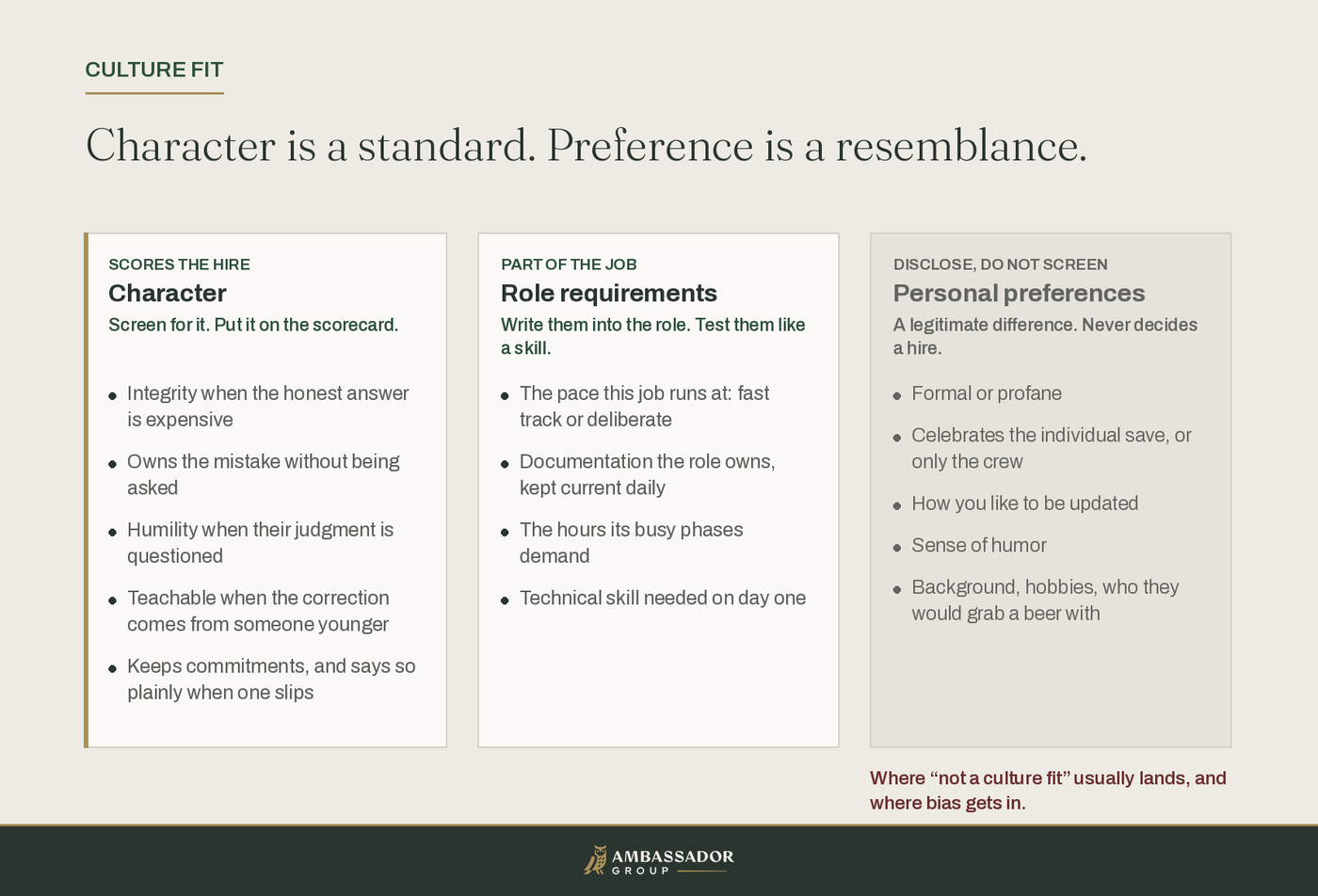
The trouble is that preferences make up a large share of what gets screened under the culture fit heading. Character is a standard. A role requirement is part of the job. A preference is a resemblance. When a hiring team calls a strong candidate a poor culture fit and cannot name a character concern or a requirement of the role, what they usually mean is that the person is unfamiliar. That is how a company becomes homogeneous, one defensible-sounding decision at a time.
A pattern I have seen play out: a construction firm needs a senior project manager for a growing pipeline of large jobs. The candidate has fifteen years of experience, strong references, and a record of on-time completion. After an informal lunch with the leadership team, the doubts come in: the candidate did not laugh at their jokes, seemed too direct, might not mesh with the team. They pass. The person they hire instead fits in socially and struggles with subcontractors and jobsite conflict. Six months later they regret it, and by then the stronger candidate is running jobs for a competitor. The lunch measured social comfort. The job measured something else.
Screening for character is easier to defend in a debrief, because you can point to a behavior you scored. From the inside, screening for sameness feels identical, and that is the danger.
When "fit" is covering for a leadership gap
There is an uglier version. Sometimes "culture fit" is code for "someone who can tolerate chaos." Leadership is spread thin, accountability is absent, direction changes every other week, and the hiring language gives it away: someone who can roll with the punches, low ego and high output, a fast-paced environment. Translated, that is a request for a person to cover the leader's gaps. The high-character, hard-working person you hire into that structure tends to burn out holding it up. The structure caused that burnout. If a manager keeps hiring people to offset their own dysfunction, coach that manager.
When fit means a match to your problems
The same thing happens at the scale of a whole company. Picture a culture with a real problem in it: bad news that dies two levels down, a leader whose temper sets the agenda, a standard that bends for the biggest client. That company will experience certain candidates as a strong fit. Some fit because they carry the same problem and have worked around it for years until it reads as normal. Others fit because they are desperate enough to overlook it, or simply cannot see it. The interview feels easy, the chemistry feels real, and the hire reinforces the thing that most needed to change.
A strong fit signal tells you the candidate matches the company. It does not tell you which part of the company they match. That is why reading your culture comes first: if you have not run the five tests honestly, you cannot tell a candidate who fits your standards from one who fits your dysfunction. Screen against the written standards, and treat an unusually comfortable conversation as something to check, not a verdict.
Hire people who carry the culture
Fit is a low bar even when it is defined well. A better one is whether a person will carry the culture. A net-positive hire does five things consistently:
1. Understands what the company values and why.
2. Embodies it, so daily actions match the stated principles.
3. Defends it, protecting team norms when others drift.
4. Perpetuates it, teaching new people how things are done.
5. Improves it, looking for ways to strengthen it rather than coast.
A person who does few of the five tends to drift into consuming the culture. A culture consumer draws on the clarity, stability, and camaraderie a strong environment provides without doing anything to sustain it. They are usually agreeable, and hard to name because nothing they do looks toxic. The tells are small: they talk about what the company should do for them, rely on others to hold the standard, mistake comfort for health, and resist accountability and change politely. Someone makes up the difference, usually your best people, and the leader feels the drain before being able to explain it.
Three questions sort a current team quickly. Who leaves things better than they found them? Who only benefits from the culture others maintain? Who corrects drift, and who tolerates it?
The people who will wreck it
At the far end are people who dismantle a culture, often while looking productive. One of the most expensive patterns I have watched: a hire who passes the interview, hits their numbers, and wears down the team around them for eighteen months before anyone names it. They show up as talent.
The patterns are familiar once named, and each one shows in behavior long before anyone has to guess at motive: warmth toward people who can help them and none toward people who cannot, taking credit for team wins, bristling at feedback, never owning an outcome, a temper that silences the people who would raise problems, micromanagement that chokes initiative, chronic cynicism, a steady supply of drama, and agreeing in the meeting while underdelivering in silence.
Discernment matters here. Plenty of difficult people are not toxic at the root, and the clearest way to tell is how they respond to correction. An inexperienced manager who micromanages may learn to trust once someone names the behavior and coaches it. The pattern that does not move after clear, documented feedback is the one that poisons a culture. Both cost the team something. Only one of them responds to coaching. Telling them apart is the leader's job, and it cannot be handed to a gut feeling, because gut feel is exactly what a polished narcissist wins on.

Screen for it without the theater
The interview mechanics live in How to Interview and How to Design an Interview Process: lanes, structured questions, written feedback before discussion, references against the same behaviors you scored. What follows is how culture plugs into that process.

Screen for values early. Before you spend an hour on experience, find out how the person thinks about the things you will not compromise on. What kind of environment brings out their best work, and what shuts them down? What does accountability mean to them? How do they define quality? If the answers run against how you operate, end it there, kindly.
Ask what it cost them. Belief shows up in choices made under pressure, so the questions have to reach those choices. Tell me about a decision that cost you in the short term because it protected a principle. When a teammate cut a corner at 4:45 on a Friday, what did you do in the next ten minutes? What belief would you resign over? Then push for names, dates, and artifacts, and, with the candidate's consent, talk to the reference who can confirm the story. Anti-evidence is just as useful: blame that only flows downward, vague claims of being a great culture fit, and glory stories with no numbers and no lessons.
Watch what happens to small commitments. Character shows under load, and a hiring process runs under polite conditions, where everyone is on their best footing. The process still produces real evidence. When a candidate says they will send something by Thursday, notice whether it arrives, and if it does not, how they handle the miss: do they own it plainly, explain it credibly, or go silent? Ask what they missed at a job that disappointed them, and listen for whether they describe their own part. Give them a scenario with no clean answer and watch which way they lean when the tradeoff bites. None of this is a trap. The candidate is evaluating you at the same time, and a process that treats them with respect is part of what they are reading.
Tell them the hard parts. If your model prizes documentation and someone who hates daily logs will be miserable, say so in the first conversation. If you expect candid pushback when risk is rising, say that too. This is informed consent, and it works in both directions: the unaligned opt out and the aligned lean in.
Score it. Put the behaviors from your values list on the scorecard, train interviewers to rate against them, and make "not a culture fit" an inadmissible comment unless it names a behavior. That single rule helps reduce bias at the point where the hiring decision gets made.
Know what can grow after the hire and what cannot. A gap in skill or context can close with good onboarding. A gap in belief about the work usually does not. Hire for evidence plus teachability.
Culture is kept by what you tolerate
A culture gets maintained or spent every week after the hire, mostly by what the leader rewards and what the leader lets slide.
Real culture runs on four systems, and when any of them stays vague, cosmetics move in to fill the space:
- Decision rights: who decides what, with what input, by when.
- Standards: what "done," "safe," "ready," and "acceptable risk" look like, written so they can be observed.
- Feedback loops: short cycles that bring bad news up quickly, including postmortems with named owners.
- Consequences: rewards and corrections that follow the standards.
That last one is where cultures tend to leak. Growth means no one gets a pass for having been around longest, and there is no separate rulebook for the old crew and the new hires. Put the values into performance reviews. Announce every promotion with the behaviors and outcomes that earned it, so people can see what the company rewards. Confront misalignment early and consistently, because the first small manipulation you tolerate publishes what is acceptable. This is leadership work, and it stays with the leaders. They set the tone, supervisors enforce it, and the whole company watches what you do far more closely than what you say.
The landing is where a new hire learns which version of your culture is real, which is why the plan for it belongs in how you onboard and why the long-run version belongs in how you keep people.
Three questions, answered with evidence and not opinion, will tell you this week whether the system is working:
1. What did you praise last week, and what exact behavior did it reinforce?
2. What did you correct last week, and what changed afterward?
3. What tradeoff did you make that cost you in the short term but protected your standards?
No evidence means cosmetics are running the company.
Run the test on yourself first
Everything above eventually points back at the person doing the hiring. You cannot screen someone for convictions you have not articulated in yourself, and the quality of the team you build tracks the clarity of the leader building it. A strong hire needs something real to attach to, and when the center is vague, the strongest people tend to be the first to leave.
So start with three lists. In the first, write the three or four standards you hold when they cost you something. In the second, write what the next role you are filling requires: the pace the job runs at, the documentation it demands, the hours its busy phases take. In the third, write the things you simply prefer: formality, how you like to be updated, the kind of humor you enjoy. In my experience, few leaders have separated these, which is why their culture fit conversations stay fuzzy. The first list is your culture, and it scores the hire. The second belongs in the job description and gets tested like any skill. The third is preference: tell candidates about it, and never let it decide a hire.
Your character will show eventually, and so will every candidate's. You decide whether you learn it during the interview or during the crisis.
The short version.
- What is company culture, in practical terms?
- It is what a company does when doing the right thing costs money, time, status, or comfort. It shows up in who gets promoted, what gets funded, what gets tolerated, and how fast bad news travels. Slogans, perks, and a values poster are cosmetics; they become culture only when they hold under pressure.
- Is company personality the same as company culture?
- No. Personality is a company's temperament, introverted or loud, playful or serious, formed mostly by its leaders, and it may or may not reflect what the company believes. Culture is what the company does when doing the right thing costs something. A charming, fun workplace is no more proof of kindness than a charming candidate is proof of character.
- How do I find out what my company's real culture is?
- Look at what happened when something was at stake. Review your last three big spends and cuts, who got promoted and why, how dissent is handled when a senior person is wrong, how a missed date is handled and who hears first, and how fast bad news surfaces. Then ask three to five employees to describe the culture in one sentence; if the answers differ, the culture is not yet defined.
- What is the difference between culture fit and character?
- Character is a person's held standards for behavior under pressure, such as integrity, humility, ownership, and teachability, and it scores the hire. Role requirements, such as the pace a job runs at or the documentation it demands, belong on the job's scorecard and get tested like any skill. Personal preferences, such as formality, humor, and how wins get celebrated, are resemblances, and screening on them is how bias enters a hiring process.
- How many core values should a company have?
- Three to five, and only ones you would lose a project over. Translate each into two observable behaviors, one behavior that violates it, and a recent story where it cost the company something. A value you cannot test in an interview is not a hiring filter.
- Why can a strong culture fit be a warning sign?
- A company with a dysfunction in its culture will feel some candidates as a natural fit because they share the problem, are desperate enough to overlook it, or cannot see it. Fit tells you the candidate matches the company, not which part of it they match. Read your own culture first and screen against written standards, not against how comfortable the interview felt.
- What is a culture consumer?
- A culture consumer draws on the clarity, stability, and camaraderie a strong team provides without doing anything to sustain it. They are usually agreeable and rarely look toxic; the tells are talking about what the company should do for them, relying on others to hold the standard, and resisting accountability politely. Someone else makes up the difference, usually your best people.
- What toxic patterns should leaders name early?
- Taking credit for team wins, bristling at feedback, never owning an outcome, a temper that silences people, micromanagement that chokes initiative, chronic cynicism, steady drama, and agreeing in the meeting while underdelivering afterward. Judge the behavior, not the motive, and watch how the person responds to clear, documented correction. A pattern that changes with coaching is a development need; one that does not move is the one that damages a culture.
- Which common culture phrases hurt hiring?
- "We are a family," "work hard, play hard," "we only hire A players," and "our door is always open" each tell candidates something the leader did not mean: unconditional loyalty that employment cannot return, long hours as a social obligation, rescues over the crew work that prevents them, and an escalation path that puts the burden on the person with the least power. Replace each with a plain description of what the company does when the standard costs something.
- Can you hire your way out of a weak culture?
- No. A strong hire needs a clear center to attach to, and when standards, decision rights, and consequences are vague, the strongest people tend to leave first. Define the culture, then hire people who will understand, embody, defend, perpetuate, and improve it.


