
The quality of a hire is set by the leader long before the candidate walks in. So is the bias, and so is the legal exposure. A leader who cannot see their own assumptions cannot see the candidate in front of them, and an interview is exactly where that blindness becomes visible and expensive. Most interview slips do not come from prejudice. They come from a leader who never decided in advance what they were measuring, so curiosity, small talk, and gut feeling rush in to fill the gap. The EEOC exists to keep people from being judged on things that have nothing to do with the work. The leaders who stay clean are the self-aware ones who know exactly which lane they are in and why.
Hiring should be fair, simple, and about the work. The discipline starts with one habit: ask about the job, not the person. That single habit does two jobs at once. It removes the questions that create legal risk, and it strips out the bias those questions quietly carry in.
Construction makes this harder than most industries. The trades run on relationships, on shared job sites and long days, and the instinct to size a person up over a cup of coffee is the same instinct that gets a leader in trouble. "Would I want this guy in my trailer" feels like judgment. Half the time it is bias wearing judgment's jacket. The answer is to move the warmth onto the work, where it belongs and where it is safe.
The questions that keep you clean
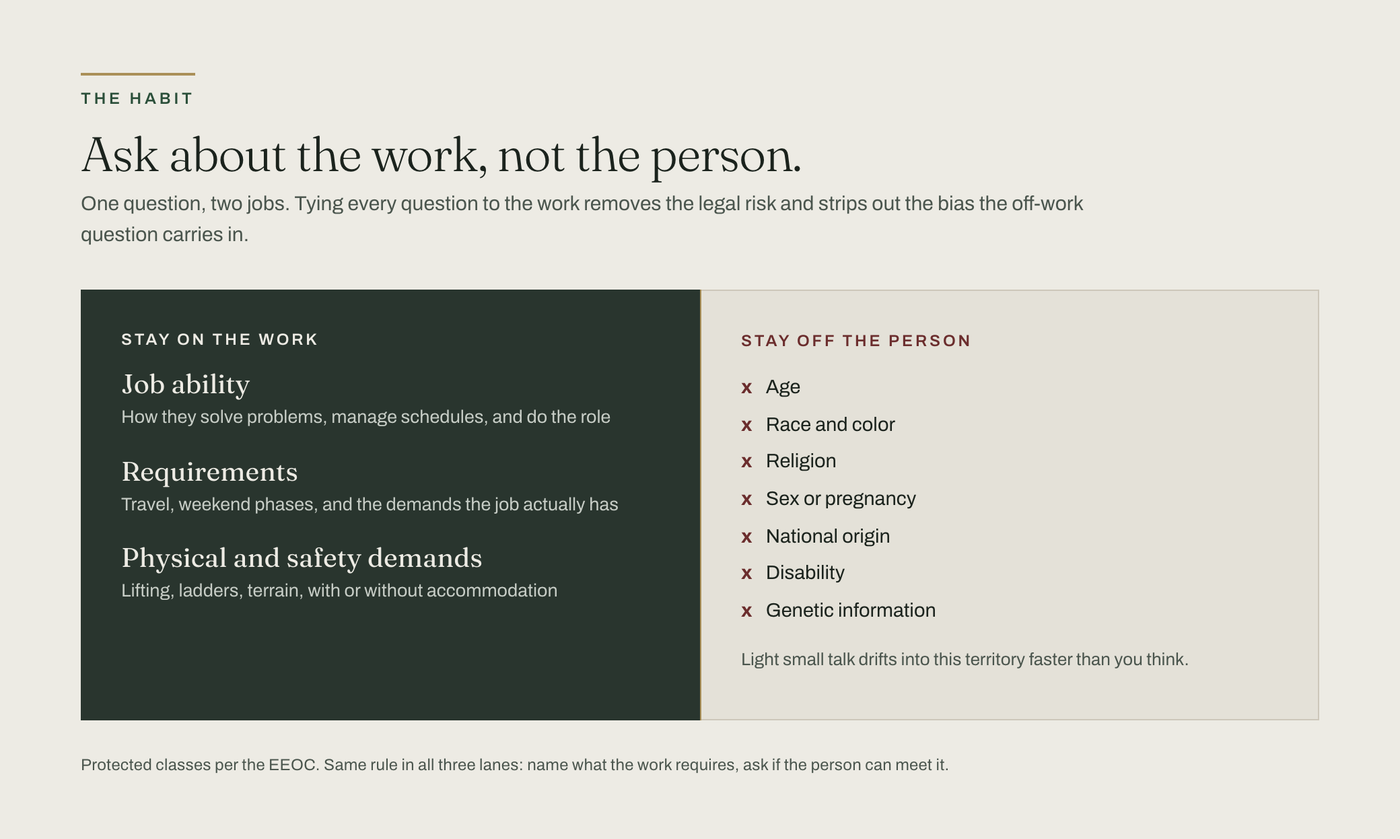
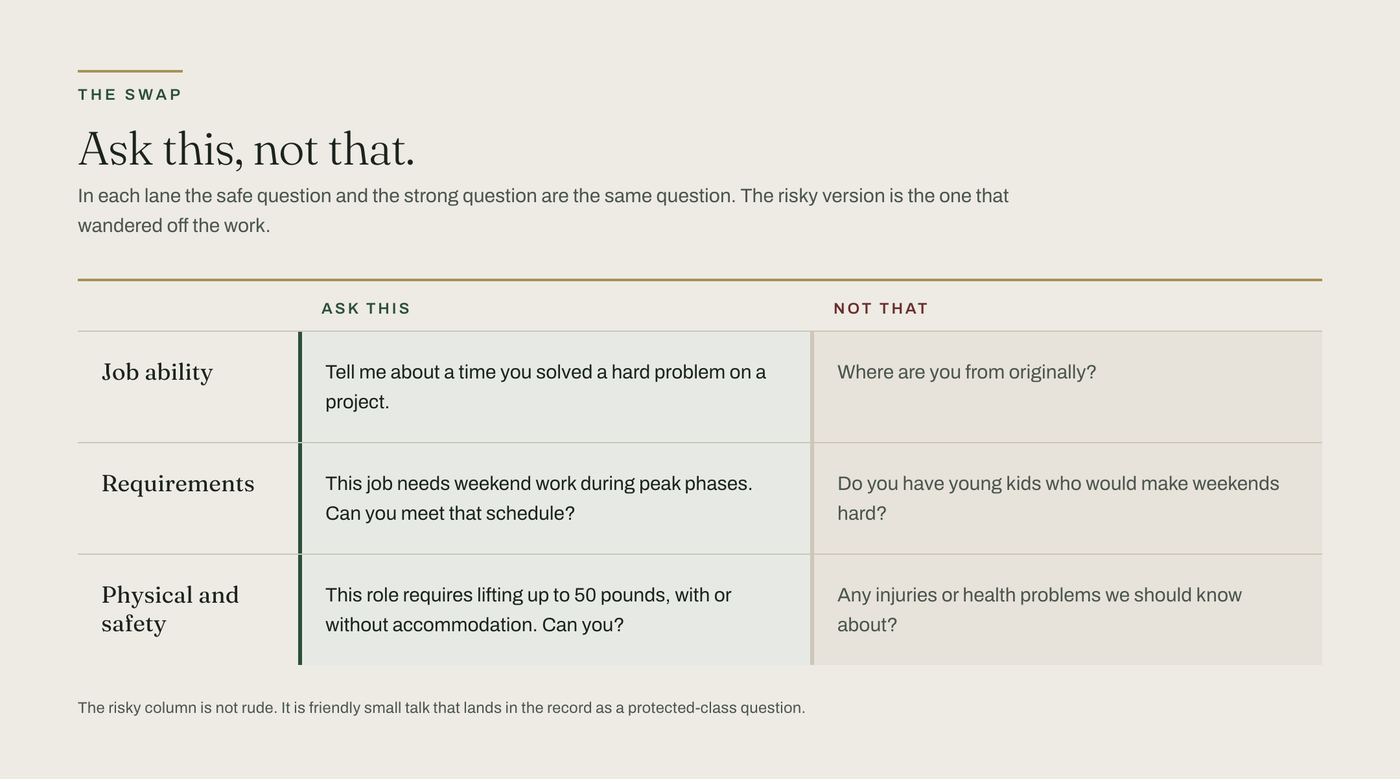
Three lanes cover almost every question worth asking. In each one, the safe version and the strong version are the same question. The risky version is the one that wandered off the work.
Ask about job ability, not personal identity
Tie every question to how the person will do the work:
- Tell me about a time you solved a hard problem on a project.
- What parts of this role fit your strengths?
- How do you manage tight schedules and changing demands?
- What support helps you do your best work?
Do not touch protected-class topics: age, race, color, religion, sex or pregnancy, national origin, disability, or genetic information. Light small talk drifts into that territory faster than you think.
Ask about requirements, not family or lifestyle
Be direct about what the job demands:
- This job needs weekend work during peak phases. Can you meet that schedule?
- This role requires travel between job sites. Are you able to do that with or without accommodation?
Do not ask about kids, plans for kids, or personal routines. These feel normal in life and risky in an interview.
Clarify physical and safety demands, not health history
The job's physical requirements are fair game:
- This role requires lifting up to 50 pounds. Are you able to do that with or without accommodation?
- Are you able to climb ladders and walk uneven terrain with or without accommodation?
Do not ask about personal health, disability, or past injuries. That crosses into protected space fast.
The pattern is the same in all three. Name what the work requires, ask whether the person can meet it, and stay out of who they are.
The bias under the bad question
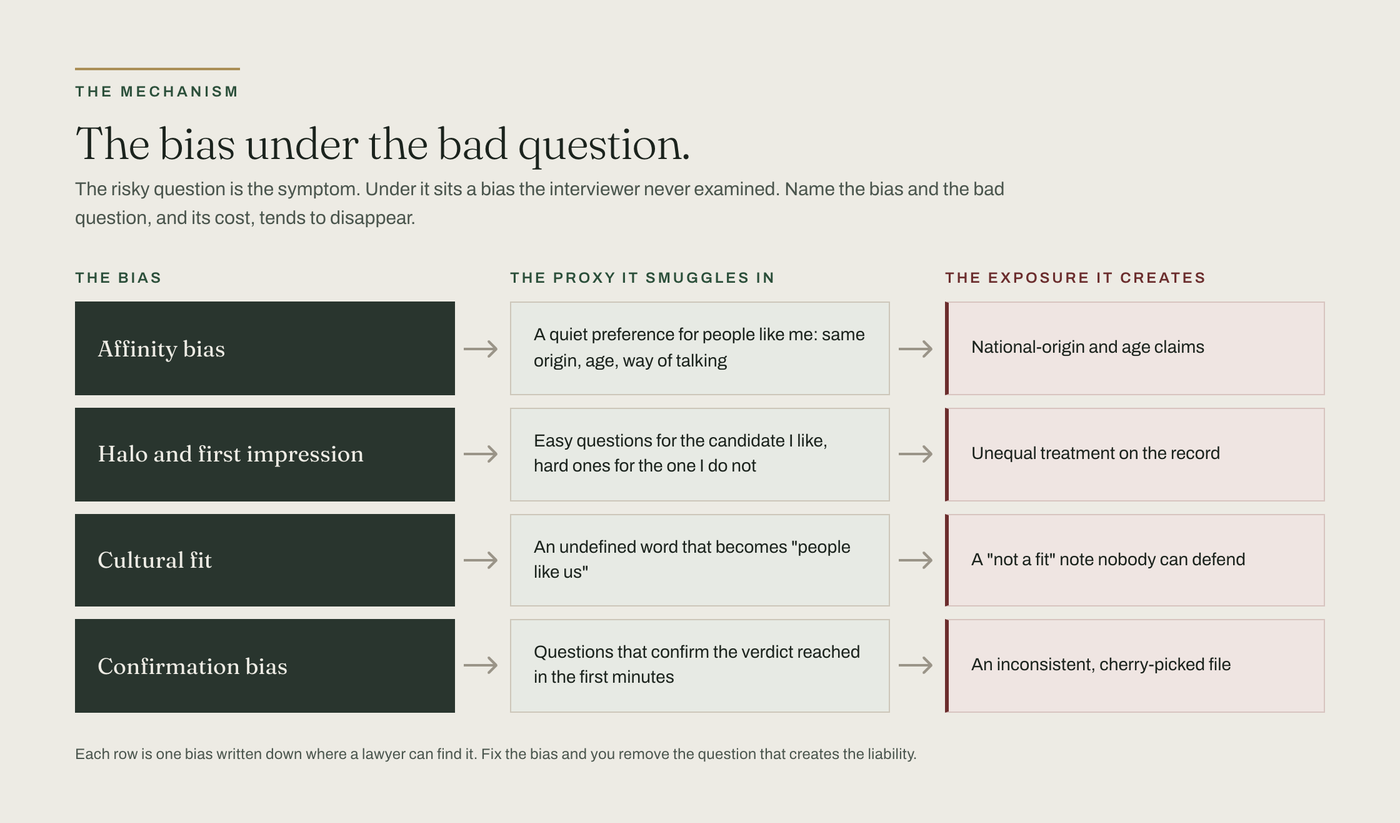
The risky question is rarely the disease. It is the symptom. Under almost every protected-class slip sits a bias the interviewer never examined. Name the bias and the bad question tends to disappear on its own. Four of them do most of the damage in construction hiring.
Affinity bias: hiring your own reflection
The most common and the most expensive. You warm to the candidate who reminds you of yourself: same background, same trade school, same way of carrying a conversation. It feels like chemistry. On the page, a steady preference for people who share your origin, your age, or your way of talking reads like exactly what the EEOC was written to catch. The candidate who would have stretched your team is often the one who felt least familiar in the first 10 minutes.
The halo and the first impression
A firm handshake and a confident open, and the brain fills in competence it has not verified. The halo is what makes an interviewer ask easy questions of the candidate they already like and hard ones of the candidate they do not. Unequal questioning is unequal treatment, and it produces a worse read on top of the legal exposure. (More on this in Relying too much on first impressions.)
Cultural fit: the bias that hides in plain sight
"Fit" is the most dangerous word in hiring, because it sounds like judgment and behaves like preference. When a team cannot define what fit means, fit quietly becomes "people like us." A rejection note that reads "not a cultural fit," written by a company that cannot define the term, is a settlement waiting to happen. Hire for the values and behaviors the work demands, and say those out loud. (This is the whole argument of Cultural fit is a trap.)
Confirmation bias: the interview you decided in the parking lot
Once an interviewer forms a view in the first few minutes, the rest of the hour becomes a hunt for evidence that supports it. The questions stop testing the candidate and start confirming the interviewer. The result looks like diligence and works like a rubber stamp.
Contrast effect: judging against the last person, not the job
Interview a weak superintendent at 10, and the average one at 11 looks like a star. Interview a standout first, and a solid candidate behind them looks thin. The candidate gets measured against whoever sat in the chair before, instead of against the work. On a busy hiring week with back-to-back interviews, this one is almost automatic, and it scrambles the order in which good people get advanced or cut.
Each of these is a failure of self-awareness before it is a failure of compliance. The bill arrives as legal risk, but the root is a leader who never checked their own thumb on the scale. Judging a person on the work, and only the work, is the respectful move as much as the safe one. It is what it looks like to take a candidate seriously as a professional rather than as a type.
Where the liability comes from
The risk you remove by staying disciplined
This is about liability before it is about compliance. One careless question or note can turn a normal hiring decision into a legal fight. Once a personal detail is in the record, it can be used against the company even when the decision had nothing to do with it.
Staying clean removes three exposures:
- Evidence. A single comment can become the candidate's whole case.
- Settlement pressure. Weak claims still get expensive, because defense costs are high.
- Pattern exposure. Repeated sloppy steps start to look like bias even when they are not.
A large share of claims do not start with real discrimination. They start when the interviewer drifts into personal topics. Once that detail is in the notes, the candidate can argue it shaped the choice. Some candidates know how to use that opening, and some attorneys know it better.
Construction adds its own accelerant. A project is short-staffed, a start date is slipping, and the hire gets rushed. Rushed interviews skip the form, lean on first impressions, and produce notes written fast and loose. The same schedule pressure that makes a manager want to fill the role today is the pressure that writes the sentence a lawyer reads tomorrow.
How companies trip themselves
Every example below is a bias from the last section, written down where a lawyer could find it.
- The note that sank the defense. A manager wrote "Seems older, might not keep up." The real issue was software skill. That is affinity and age bias on the page. The company settled.
- The helpful comment that hurt. A manager told a rejected candidate, "You might be happier in a less physical role." They meant kindness. It read as an assumption about disability. The company paid.
- The HR contradiction. Interview notes mentioned family plans while HR told the EEOC the decision was based only on certifications. The mix of reasons pushed the case forward. The company paid.
- The small-talk slip. "Your English is great, by the way" tied directly to national origin. After the rejection, it became the heart of the claim.
- The stray joke. "We need someone with real adulting skills" became a younger manager's evidence of age bias. The case survived. Settlement followed.
- The "fit" problem. A rejection note read "Not a cultural fit," and the company could not define it. Optics beat intent.
What these slips cost
These mistakes are ridiculous and expensive, and it is fair to ask whether parts of the system have become a cash-grab. Settlements cluster on a spectrum that climbs with the quality of the evidence against you:
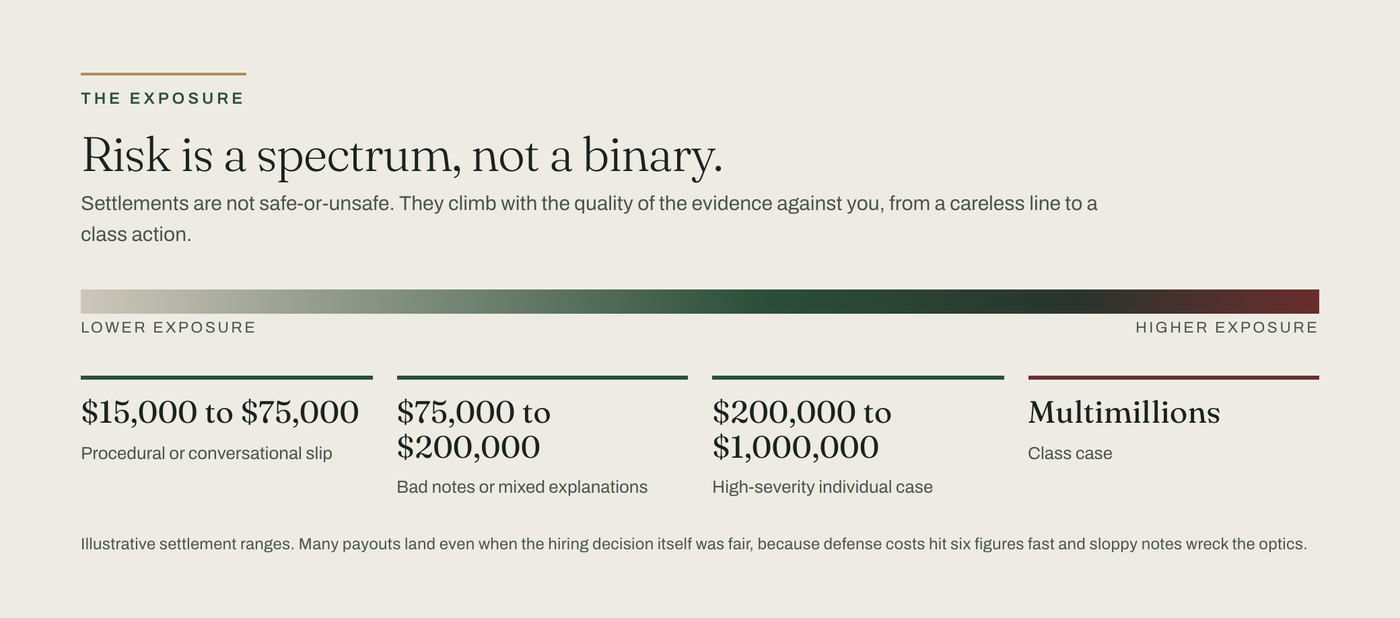
The hard part to swallow is that many of these payouts happen even when the hiring decision itself was fair. Companies pay because defense costs hit six figures fast, sloppy notes make the optics terrible, and inconsistent explanations weaken the defense.
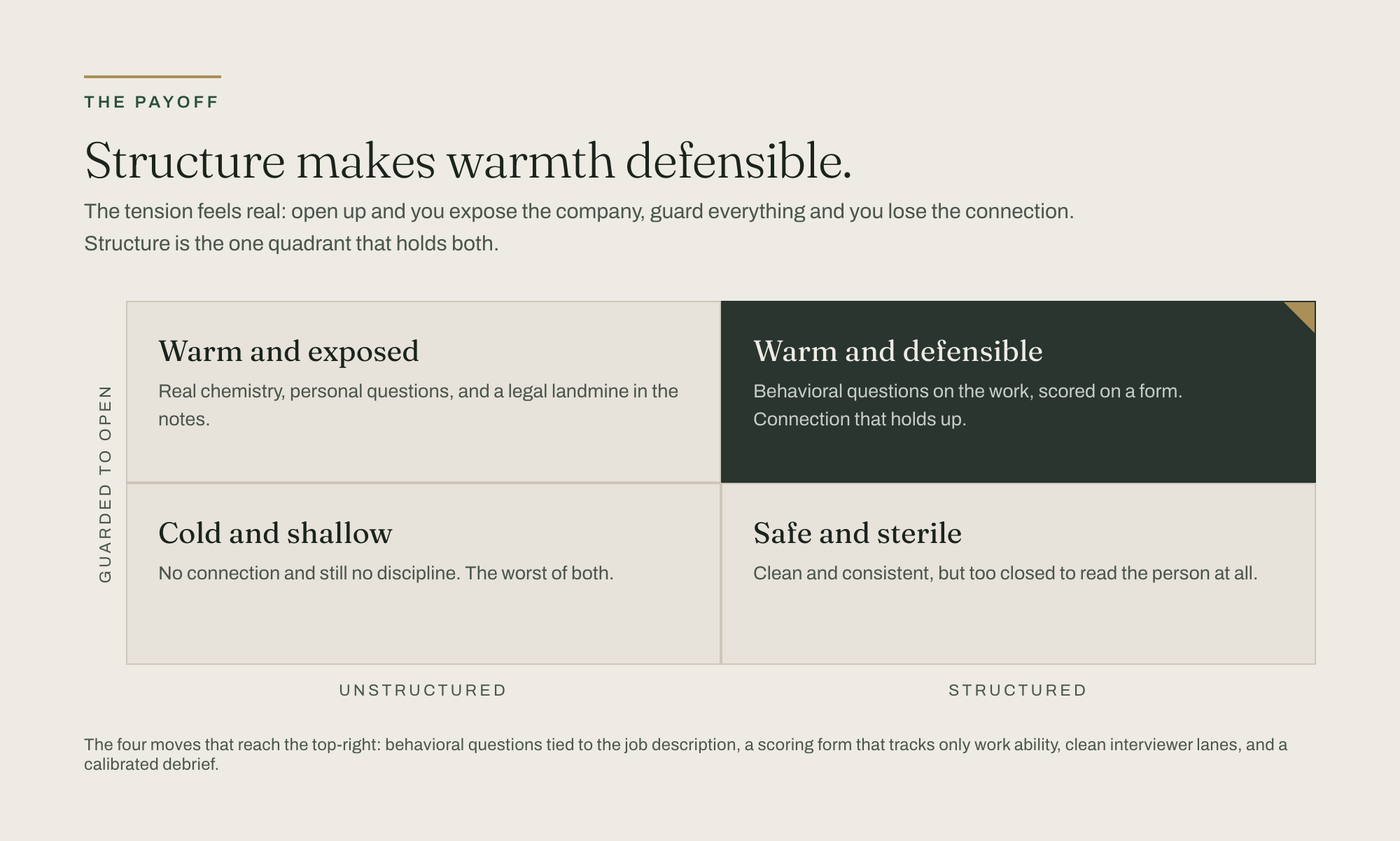
Structure makes warmth defensible
The tradeoff that structure dissolves
Good interviews run on real connection. Strong working relationships grow from honest stories and human warmth. Today that same warmth can trigger risk. Open up, and you expose the company. Guard everything, and you weaken the connection you need to hire well. A structured interview holds both ends at once. It keeps personal topics off the table and still lets a candidate tell you how they think, what they value, and how they solve problems. That is where real connection happens, and it is safe ground.
Structure is what makes warmth defensible.
The four moves that take the bias out of the interview
The same four moves that keep you legally clean are the ones that strip bias out of the read:
- Behavioral questions tied to the job description. Ask for specific past situations, and let the job description be the rubric. A question anchored to the work cannot wander into who the person is. (The Hire in 4K method calls this interviewing against the job, not against your gut.)
- A scoring form that tracks only work ability. If a factor is not on the form, it does not enter the decision. The form disciplines the affinity and halo reads, and it doubles as your evidence that the decision was about the work.
- Clean interviewer lanes. Give each interviewer a defined area to probe so no one freelances into personal territory, and so two interviewers are not both running on first impressions.
- A calibrated debrief. Everyone scores independently before anyone speaks, then you compare. A debrief is a stress test of the evidence, not a vote on who liked whom.
Run the interview this way and the warmth survives, because the structure is carrying the risk instead of the conversation.
There is a dignity argument underneath the legal one, and it is the more important of the two. A candidate who is judged on a clear standard, asked the same real questions as everyone else, and scored on the work, has been treated as a professional. A candidate who is sized up on background, accent, age, or how much they remind the panel of themselves has been treated as a category. Structure is how a leader extends the same respect to every person who walks in, which is the whole point of fair hiring before it is ever a matter of avoiding a claim.
Risk is a spectrum, not a binary
Most people talk about risk as if it were clean and binary. Safe or unsafe. Allowed or not. Real operators know it never works that way. Risk lives on a spectrum, and it shifts with context, documentation quality, interviewer discipline, and the strength of the process.
The best leaders do not hide behind rigid rules. They work with intention and judgment. They know where the real exposure sits and how to reduce it without killing the human side of hiring. That is the mature way to think about EEOC risk: thoughtful, repeatable behavior that keeps the company safe while leaving room for connection and insight. Across every one of these, the lever is the same. It is the discipline of the person across the table. (When a hire does go wrong, diagnosing it honestly almost always leads back here.)
Further reading from the EEOC
Prohibited Employment Policies and Practices
Employment Tests and Selection Procedures
Best Practices for Employers and Human Resources Professionals
For the companion piece on keeping the standard high while you stay clean, see EEOC compliance without compromise.
You decide where the lines are before the interview starts, or the record decides for you.
The short version.
- What interview questions create EEOC legal risk in construction hiring?
- Questions that wander off the work and into protected-class territory: age, race, color, religion, sex or pregnancy, national origin, disability, or genetic information. Most slips come not from prejudice but from small talk filling a gap the interviewer never planned, so the discipline is one habit: ask about the job, not the person.
- How do I ask about schedule or physical demands without breaking the law?
- Name what the work requires and ask whether the person can meet it. Say "this job needs weekend work during peak phases, can you meet that schedule" instead of asking about kids or routines, and "this role requires lifting up to 50 pounds, are you able to do that with or without accommodation" instead of asking about health history or past injuries.
- What biases cause most interview problems in construction?
- Four do most of the damage: affinity bias, warming to the candidate who mirrors your own background; the halo effect, letting a firm handshake stand in for unverified competence; cultural fit used as undefined preference for "people like us"; and confirmation bias, spending the hour hunting evidence for a view formed in the first minutes. The risky question is rarely the disease; it is the symptom of an unexamined bias.
- Why do companies pay settlements even when the hiring decision was fair?
- Because defense costs hit six figures fast, sloppy interview notes make the optics terrible, and inconsistent explanations weaken the defense. A single careless comment can become the candidate's whole case once it is in the record, and repeated sloppy steps start to look like a pattern even when they are not.
- How can an interview stay warm and human without creating legal exposure?
- Structure is what makes warmth defensible. Four moves carry the risk so the conversation does not have to: behavioral questions tied to the job description, a scoring form that tracks only work ability, clean interviewer lanes so nobody freelances into personal territory, and a calibrated debrief where everyone scores independently before anyone speaks. A candidate judged on a clear standard has also been treated as a professional, which is the point of fair hiring before compliance ever enters it.


