
Pilots have a phrase for flying on instinct alone: flying by the seat of your pants. It can be done. It has been done for as long as there have been airplanes. Gut hiring works the same way, and it carries the same problem. Your senses feel most reliable at the exact moment they are lying to you. Leaders who can't see themselves clearly can't see candidates clearly, and hiring is where that blind spot gets expensive. The fix isn't better candidates: it's better leaders who own the process.
The pilot in command
Federal aviation rules give one person the final word on every flight. The pilot in command "is directly responsible for, and is the final authority as to, the operation of that aircraft." Dispatch can advise. Air traffic control can warn. The copilot can speak up. When the wheels touch down, one person owns the result.
A hire has a pilot in command too. It is the hiring decision leader. Search partners, assessments, references, and interview panels all feed the cockpit, and none of them fly the airplane. The leader decides who gets hired, defines what success looks like, and decides how well to support the new hire once they start. That makes the outcome the leader's, whether it lands smoothly or ends up in the trees.
Most leaders accept this in theory. Far fewer act like it when a hire goes wrong.
The runway you can't see
Every approach starts with a runway: its location, its heading, its length. A pilot who can't describe the runway can't land on it, no matter how skilled they are with the stick.
In hiring, the runway is the leader's desired outcome. What does this person need to have done by month twelve? What problems will they own? What does a good day look like in the field, and what does a bad one look like? The precision of that answer sets the precision of everything downstream: who gets sourced, what the interview tests for, and how the first ninety days are built.
When the outcome is vague, the search drifts. The interviews turn into conversations about likability. The offer goes to whoever felt best in the moment. The leader is flying toward where they think the airport is.
The pattern I see over and over
I've watched the same failure play out more times than I can count, and it follows a tight script.
A leader with limited hiring reps and plenty of confidence meets a candidate twice. The conversation flows. The candidate tells good stories, laughs at the right moments, and sounds like the leader did at that age. The leader decides inside the first fifteen minutes and spends the rest of the time confirming it.
The hire starts. There is no written definition of success, no landing plan, and a vague handoff to a team that was never told what this person was hired to fix. The new hire guesses. Some guesses miss. By month four, the leader is frustrated, and by month six the hire is gone.
Then comes the retcon. The candidate "interviewed well but couldn't deliver." They "oversold themselves." They "weren't who they said they were." The story shifts until the failure belongs entirely to the candidate, as if the leader were a passenger on that flight instead of the one at the controls.

Picture a captain who bounces a landing down the runway, then tells the passengers it was the first officer's fault. Nobody in aviation accepts that. The captain didn't pick the first officer, didn't write the schedule, and didn't choose the weather, yet the landing is still theirs.
The hiring decision leader holds far more control than that captain. They pick the crew member. They define the role, set the outcome, run the interviews, make the offer, and decide how much support the new hire gets. When nearly every variable is yours, the outcome is yours too, and blaming the candidate holds up even less than blaming the first officer.
The pattern repeats because it is hard to see from the inside. A leader who hires two or three people a year never collects enough reps to separate signal from noise. Each failure looks like a one-off with its own unique villain. The meta-pattern, the one where the same leader keeps flying the same approach into the same weather, stays invisible.
Gut hiring and spatial disorientation
The interview is the windshield. It shows you something real: how a person communicates, how they think on their feet, how they treat you. Pilots use the windshield constantly. They just never trust it alone in poor visibility.
Spatial disorientation is the classic killer. In clouds or haze, the inner ear can report level flight while the airplane is in a descending turn. The pilot feels fine right up to impact. The Air Safety Institute's case study Deadly Disorientation shows how fast it happens. The cure is the instrument panel, because instruments report what is happening instead of what feels true.
Gut hiring has its own spatial disorientation. The halo effect makes one strong trait color everything else. Similarity bias rewards candidates who remind you of yourself. Urgency, the open role burning cash every week, makes a mediocre candidate feel like a rescue. Each of these feels like level flight. None of them shows up on the windshield.

The instrument panel
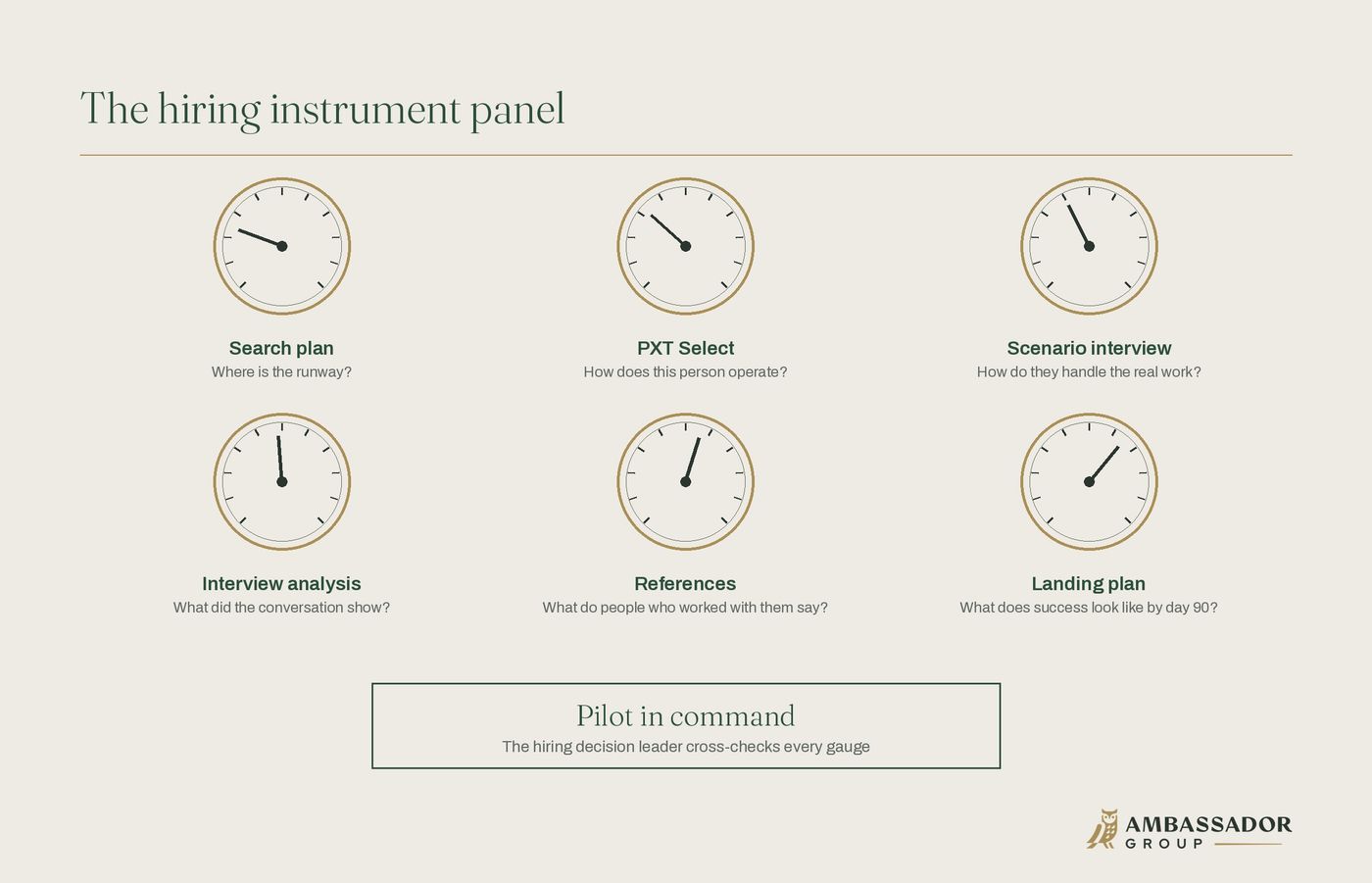
Ambassador Group's process exists to put instruments in front of the hiring decision leader. Each one answers a question the windshield can't.
The flight plan: the search plan
Before sourcing starts, the search plan pins down the runway. It defines the outcome, the conditions the hire will work in, and what the leader is optimizing for. It also gives every later instrument something to measure against.
The attitude indicator: PXT Select
PXT Select measures thinking style, behavioral traits, and interests against the role. It shows how a person tends to operate when no one is performing for anyone. It also shows the leader something about themselves, since the same assessment tells them where their own instincts run hot.
The approach chart: the scenario interview
A scenario interview puts candidates inside the real problems of the role and watches how they work through them. Stories about past wins are easy to polish. Live judgment on a realistic problem is much harder to fake.
The cross-check: interview analysis and references
Pilots never trust a single gauge. They scan, compare, and investigate disagreement. Structured interview analysis and real reference calls do the same work. When the assessment, the interview, and the references agree, confidence is earned. When they disagree, that disagreement is the most valuable data in the whole search.
Air traffic control: an outside view
ATC sees traffic the cockpit can't. An outside partner who knows the market, the compensation landscape, and the candidate's history plays the same role. The leader still flies. They just stop flying alone.
Landing is where the risk lives
Final approach and landing take only a few percent of flight time, yet roughly half of fatal commercial accidents happen in that short window. Workload peaks, margins shrink, and small errors compound fast.
In hiring, the offer, the start date, and the first ninety days are the approach and landing, and they are where most hires succeed or fail. This is where the vibe-hiring leader is least instrumented of all, because they believe the hard part ended when the candidate said yes.
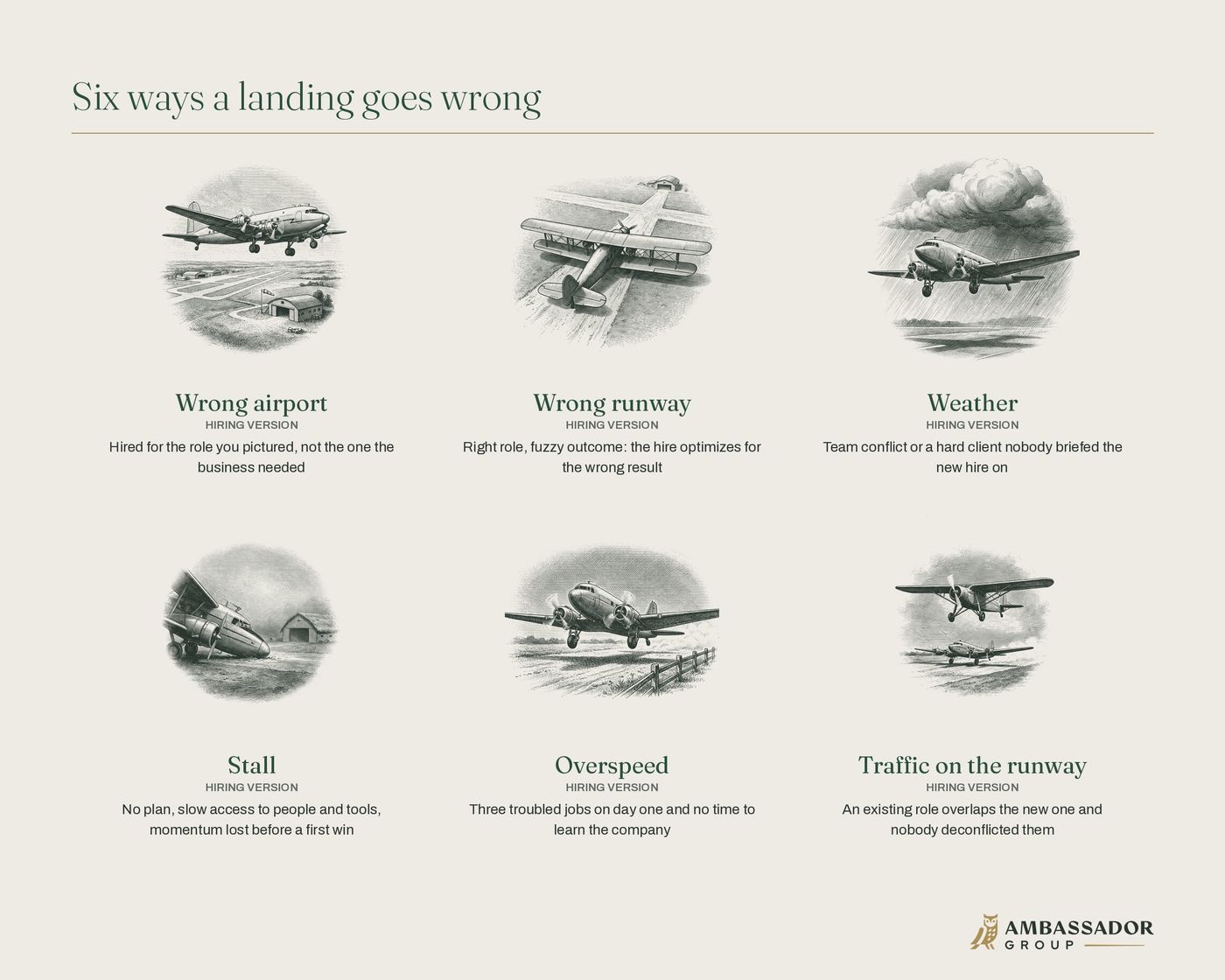
Seat-of-the-pants landings fail in predictable ways, and every one has a hiring version:
- Wrong airport. The leader hires for the role they pictured instead of the one the business needed. A strong estimator shows up where the gap was preconstruction leadership.
- Wrong runway. The role is right, the outcome is fuzzy. The new superintendent optimizes for schedule while the leader quietly wanted margin.
- Weather. A team conflict, a struggling project, or a difficult client that nobody briefed the new hire on before they flew into it.
- Stall. Too little speed on approach: no plan, slow access to tools and people, and a hire who loses momentum before the first win.
- Overspeed. Too much, too fast: three troubled jobs on day one and no time to learn how the company works.
- Traffic on the runway. An existing team member whose responsibilities overlap the new role, and nobody deconflicted the two before touchdown.
A landing plan and integration coaching instrument that phase. The new hire knows what success looks like, who they need to know, and what they are expected to fix. The leader knows what support to give and when to check in. The team knows why this person is here.
Why aviation fixed this and hiring hasn't
A business runs on as much coordination as an airport: who owns which decision, who hands off to whom, which project needs which leader by when. The difference is visibility. When a 747 cleared for San Jose lands at SFO instead, it makes the evening news, and investigators, regulators, and airlines all work the problem until it stops happening.
A hire that lands on the wrong runway makes no news. The cost shows up months later as a missed margin, a lost client, or a superintendent who quietly leaves, and by then the story has been rewritten. Nobody runs the investigation, so nothing changes.
Hiring advice makes it worse. Much of it is framed to make hiring feel easy: ask this one question and you will know everything about a candidate, spot this one tell and you will never hire wrong again. Those shortcuts are optimized for clicks, and the reader's outcomes pay for it. Quick fixes sell well to leaders who haven't yet seen how many ways a hire can go wrong. No pilot would trust a course promising that one glance out the windshield is all a landing needs.
Adopting the discipline starts with the leader shifting their own Overton window, the range of what they consider normal and acceptable in how they interview. A structured search plan, an assessment, a scenario interview, and real reference calls can feel like overkill from inside a gut-hiring habit. They are the minimum equipment for a 747.
The good news is that the discipline is already invented. The checklists, cross-checks, and single point of accountability that make it routine to ride an aluminum tube across the country at 550 miles an hour all translate to hiring. Business owners can adopt them without waiting for a crash to force the issue.
A Cessna or a 747
Not every flight needs the full panel. On a clear day, a Cessna on a short hop flies under visual flight rules, legally and safely. A forgiving airplane, a slow approach speed, and a long runway leave plenty of room for small mistakes. Many line-level hires work the same way: the role is well defined, the ramp is short, and a miss costs weeks instead of years.
A 747 is a different machine. It approaches at nearly twice the speed, carries hundreds of people, and takes miles to correct a bad decision. No airline lets a crew hand-fly one by feel, because the cost of a mistake grows with every ton and every passenger on board.
Most leaders learn to interview the way most pilots learn to fly: in small airplanes. Their hiring confidence comes from knowing the job themselves and from a string of good line-level hires. That experience is real, and it is Cessna experience. As the role's leadership impact grows, the leader's piloting has to grow with it, and many never make that jump. They fly the 747 the way they flew the Cessna, by feel and on a clear-day habit. That is where leadership hires pancake, and the damage lands on both sides: the company loses years of momentum, and a capable professional takes a career hit for a landing they were never set up to make.
A senior project manager, superintendent, or operations leader is the 747. They carry projects, client relationships, and whole teams, and a bad landing ripples through all of them for years. The discipline a hire needs scales with its complexity and its risk. Leaders who want consistently good outcomes match the rigor to the airplane, and for a leadership hire that rigor is uncompromising.
Fly the airplane
The windshield still matters, and so does instinct. Experienced pilots develop good feel, and experienced leaders do too. The professional difference is that they check that feel against instruments before they bet the airplane on it.
Ego is the enemy of good hiring, the same way it is the enemy of good piloting. The FAA trains pilots to recognize hazardous attitudes, and two of them, invulnerability and macho, describe the leader who trusts their read of a candidate over every gauge on the panel. The safest pilots are the ones most willing to admit they might be wrong. They cross-check, ask for help early, and treat a disagreeing instrument as information instead of an insult. Hiring rewards the same humility.
You are the pilot in command of every hire you make, and the landing is yours to own.
The short version.
- What does gut hiring mean?
- Gut hiring is deciding on a candidate mostly from how the interview felt. The interview shows real things, but it is one instrument, and it is easy to misread when bias or urgency is in play.
- Who is accountable when a hire fails?
- The hiring decision leader. Like a pilot in command, they decide who gets hired, define what success looks like, and decide how the new hire is supported. Advisors and assessments inform the decision, and the outcome still belongs to the leader.
- Why does the first 90 days matter so much?
- The offer, start date and first 90 days are the approach and landing of a hire. Most hires succeed or fail there, and most leaders stop paying close attention once the candidate accepts.
- Does every hire need a structured process?
- No. A low-cost, short-term or entry-level hire can be fine with a lighter touch. Senior roles at a growing general contractor carry too much risk to fly on instinct alone.


