
"Expectations are dangerous when they are both too high and unformed.", Lionel Shriver
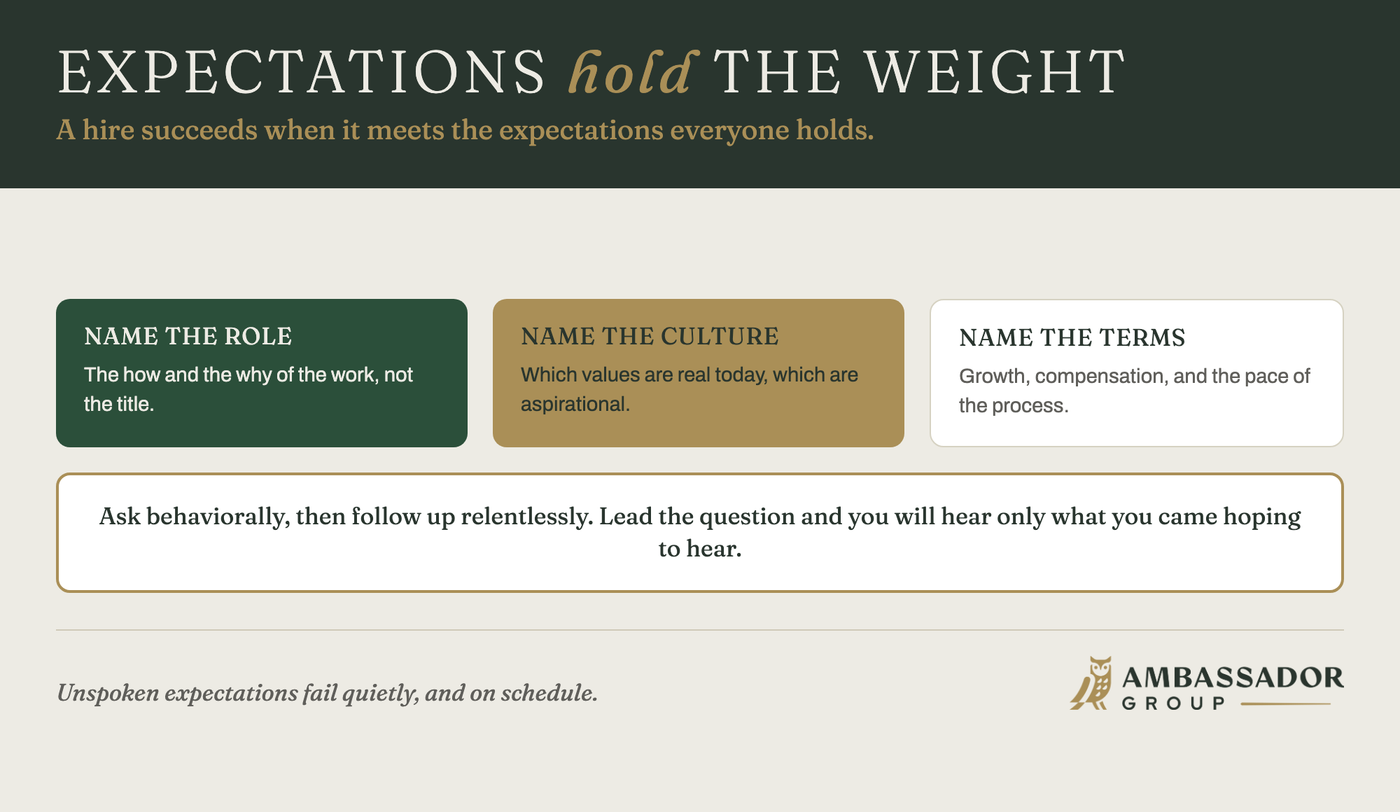
No one hires a person they expect to fail. They do it anyway, constantly. The reason is almost never the candidate. It is the leader who walked into the interview without naming what the role actually required, and walked out assuming the other person saw it the same way. A hire succeeds when it meets the expectations everyone holds. A hire fails when those expectations were too high, unspoken, or quietly mismatched, and nobody did the work to surface them. That work belongs to you. The quality of a hire is principally driven by the leader who sets the terms, and your insight into a candidate rises only as far as your own self-awareness about what you are really asking for.
Most leaders treat the interview as an interrogation: a stronger candidate produces a better outcome. The interview is not an interrogation. It is the place where two parties decide whether their expectations can hold the weight of a long relationship. Complacency from either side destines the process to fail, because each side owns the responsibility to set expectations clearly and to understand the other's. Start the conversation by naming that out loud, then weave expectation-setting through the whole interview rather than saving it for the offer. The interview should inform the candidate as much as it questions them. The same is true in reverse.
The categories worth covering
Cover each of these with real questions and specific explanation, not yes-or-no checkpoints. This is not a template. It is a mental guide to the expectations most likely to break a match if you leave them unformed.
- Candidate goals, personal and professional
- Why the role is open
- The challenges already living inside the role
- The training and onboarding process
- Current problems in the company and what the ideal solution looks like
- Company growth goals: career, revenue, projects
A clearly defined role
The most common source of misunderstanding is how fundamentally, and how subtly, two people can define the same role differently. The expectation is the how and the why of the work, not just the title. Assuming you both hold the same definition is dangerous.
Cultural expectations
- How is conflict handled, in debate, with clients, and between people?
- What does strong and weak performance look like here, and how is each one handled? Every company and every leader answers this differently.
- Which cultural values are real today, and which ones are aspirational?
- How does the team reconcile personal life and work without setting the two at odds? And when they are genuinely at odds, how do you expect those priorities to get negotiated into something sustainable?
- The company mission, the collective why.
Hiring speed
What should the candidate expect from the process and its length, and what do you expect from them inside it? Is there agreement and buy-in on both?
Career growth
What trajectory does the candidate see for themselves, and how do they define growth? Their answer rarely matches the definition you carry by default.
Compensation
- What kind of compensation actually matters to this person?
- How entrepreneurial are they? Do they want more salary, or a more aggressive bonus?
- Which benefits do they not care about, so you can move that value into salary instead?
How to ask
Cover these topics naturally. Lead the question and you will hear only what you came hoping to hear. Ask behaviorally and situationally instead, so you learn how the other person thinks the subject through rather than how well they can guess your preferred answer. Then ask follow-ups, relentlessly:
- Why do you think that is?
- What made you choose that?
- What led to that?
- What would you do differently?
- What did you learn from it?
The wisdom the categories can't give you
Setting and understanding expectations is necessary. It is not sufficient. You also have to read how committed the other side is to the right expectations. You can ask every question well and still waste the effort if the person across from you answers without the same introspective honesty. A great match requires two people willing to be transparent about what they actually want, not one skilled interviewer and one polished applicant.
None of this oversimplifies the problem. Relationships are complicated and resist being fully systematized, which is precisely what hiring keeps trying to turn them into: systematized relationships. You will not get it right every time. Much of this is easier said than done. But the disappointment that follows a bad hire is rarely the candidate's failure to be impressive. It is more often the leader's failure to name what they expected, out loud, while there was still time to find out whether the other person could meet it.
"Don't blame people for disappointing you; blame yourself for expecting too much from them.", Anonymous
The expectations you refuse to put into words are the ones that will break the hire, so put them into words before you make the offer.