
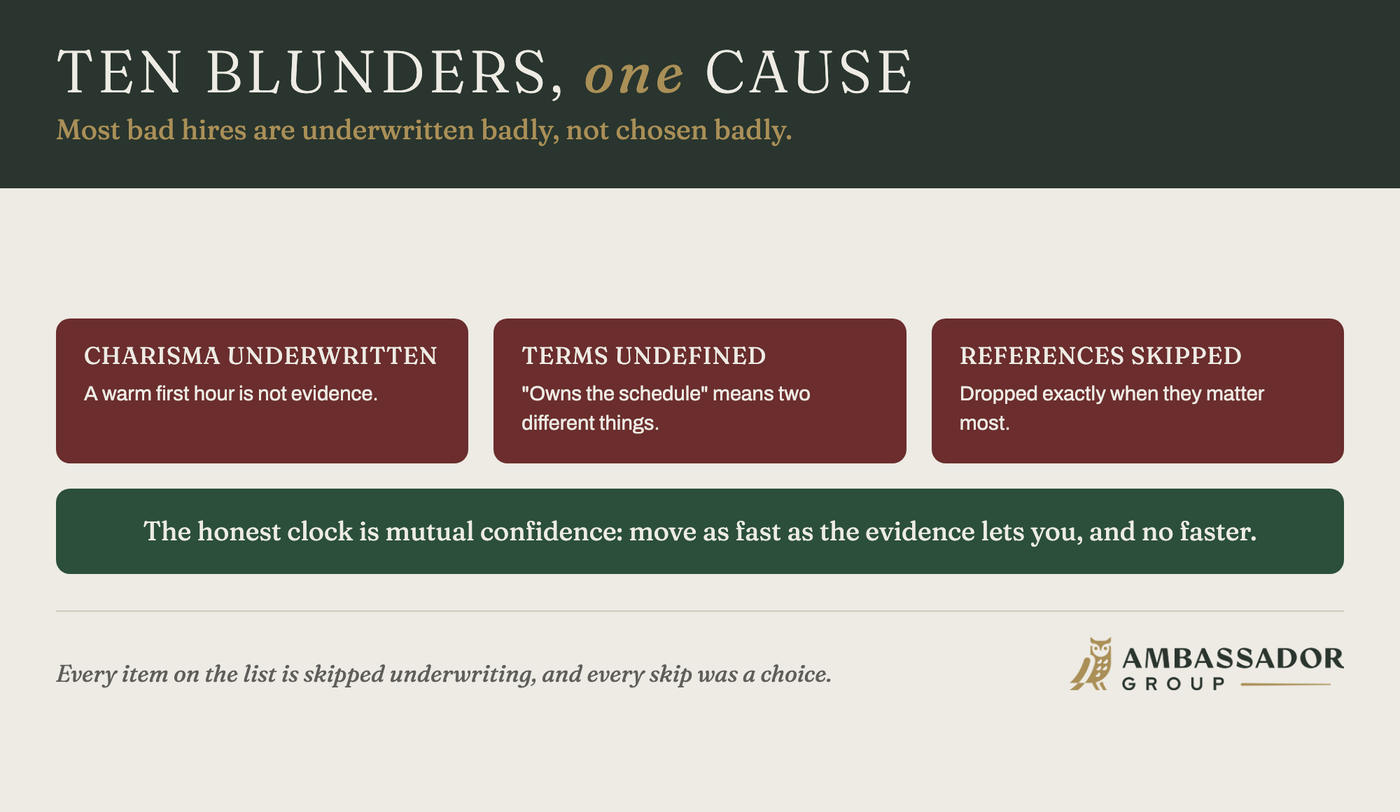
Most bad hires are underwritten badly, not chosen badly. The decision looked fine on the day it was made. What failed was the work before the decision: the questions not asked, the terms left undefined, the references never run. I have sat across enough hiring tables to know that the mistakes repeat, and they repeat because the leader treats hiring as a verdict to reach rather than a risk to underwrite.
Three beliefs sit underneath everything that follows. Your team is the most valuable thing you own. Confidently hiring the wrong person is still a failure, not a near miss. And the only success worth the name is one the new hire and the company both feel. Hold those, and the blunders below stop reading as bad luck and start reading as skipped underwriting.
The personality trap
Likability is the easiest signal to read and the least predictive. A warm first hour tells you the person interviews well, nothing more. Respect, competence, and trust are harder to surface and far more durable. When a leader hires the person they enjoyed talking to instead of the person they would stake a project on, they have underwritten charisma and ignored the loan.
The definitions you never wrote down
The most expensive assumption in any interview is that the candidate means what you mean. You say "owns the schedule" and picture one thing. They hear another. The gap stays invisible until it shows up on a job site. Define the nitty-gritty terms out loud, the standards, the processes, the skills, so the real differences surface in the room instead of in the field.
Speed set by the wrong clock
Business pressure is a terrible pace-setter. When an open seat hurts, the temptation is to move fast and call it decisiveness. The honest clock is mutual confidence: you move as fast as the evidence lets you, and no faster.
The opposite failure is just as common. A healthy, in-depth process stretched across weeks of dead air loses its thread. Both parties cool, momentum dies, and a good candidate signs elsewhere. Compress the process instead. Several conversations in a single week tells you more than the same conversations spread across two months, because you see the person in continuity rather than in snapshots.
Who is driving
An assertive candidate will run your interview if you let them. They will steer toward their strengths and away from the questions you most need answered. The room should be a give and take, not a performance you watch. The moment you stop directing the conversation, you stop underwriting and start getting sold.
The resume is a footnote
A resume is a small slice of the hiring equation, and leaders keep treating it as the whole. It tells you where someone has been, not how they think, not how they handle a bad week, not whether they will tell you the truth when a number slips. Read it, then set it down.
The stakeholders you left out
The people who will live with the hire belong in the decision. Leave out the person responsible for the new hire's success and you have made a bet on their behalf without asking them. Bring in those who will own the outcome, because they will see what you miss.
Culture you never named
If you have not defined your culture, you cannot test for fit against it. Undefined culture becomes a gut feeling, and gut feelings are how bias and sameness creep in. Name the expectations first. Then you can ask a candidate to meet a real standard instead of an unspoken one.
Fit runs both directions
Leaders interrogate whether the candidate fits the company and forget to ask whether the company fits the candidate. The relationship only holds when both parties chose it with open eyes. A match that one side talked themselves into is a resignation waiting for a calendar date. Explore the company's fit for them as seriously as you explore their fit for you.
The references you talked yourself out of
The last blunder is the one leaders skip out of confidence or fatigue. References feel like a formality once you have decided you like someone, so they get rushed or dropped. That is exactly when they matter most. A reference run with real questions is the final underwriting step, the one that confirms the loan or kills it before it costs you a year.
Every item on this list is a place where the underwriting got skipped, and every skip was a choice. The next time you feel one of them pulling at you, you already know which corner you are about to cut.