
You interviewed every bad hire you ever made. You sat across from each one, looked them in the eye, and said yes. That is the uncomfortable place this starts, because it puts the problem where the lever actually is: on your side of the table.
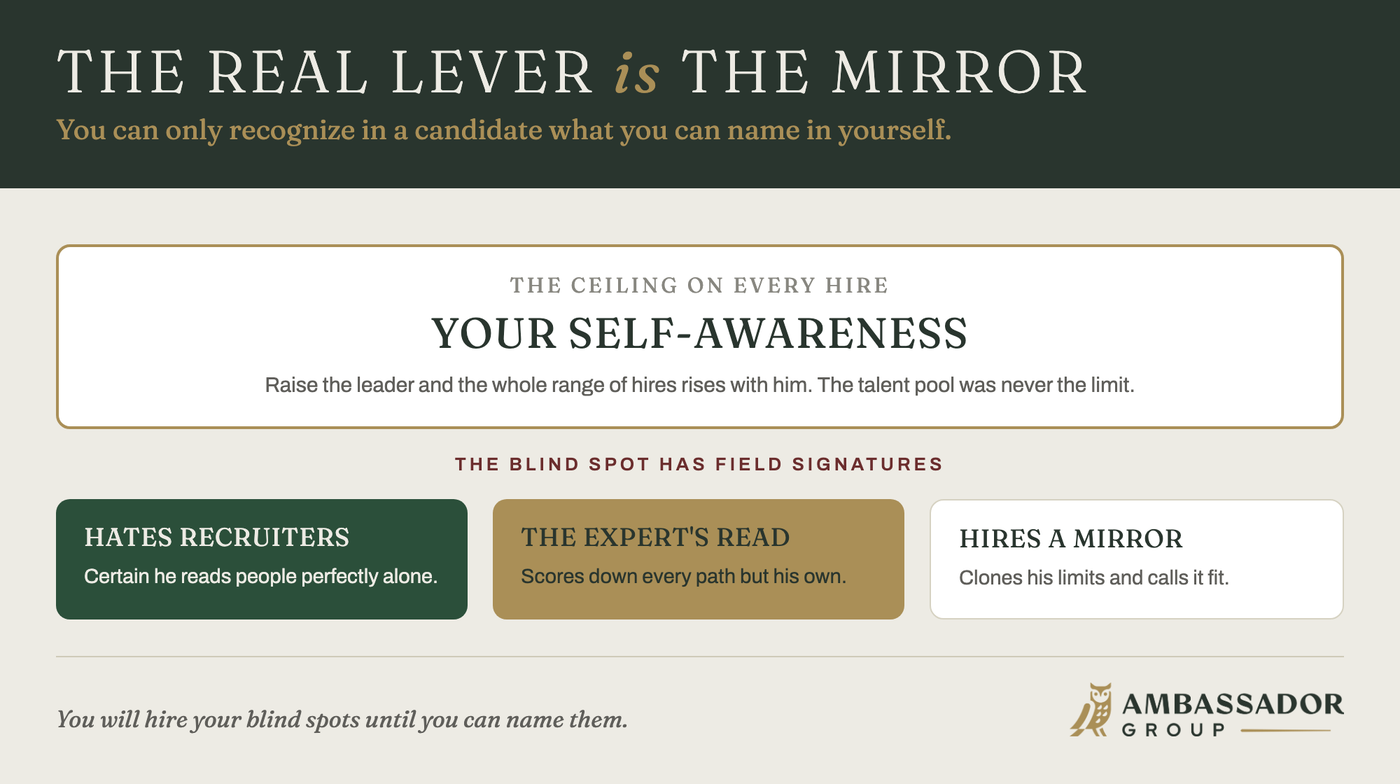
Most owners reach for a kinder story. The market is dry. The good ones are all taken. Nobody wants to work anymore. The story is comforting because it puts the cause outside the room. It is also why the next hire tends to look a lot like the last one. A leader can only recognize in a candidate what he has language for in himself. Your read of a candidate is bounded by your read of yourself, which means the ceiling on the quality of your hires is not the talent pool. It is your own self-awareness.
Two leaders can fish the same market and pull different people out of it. Same town, same wage scale, same shortage of superintendents. One keeps landing people who stall by month six. The other keeps landing people who compound for years. The water is identical. The difference is the person holding the rod.
The Story That Keeps You Stuck
Candidate quality is the comforting lever because it asks nothing of you. If the problem is the market, the fix is to wait, to widen the net, to pay more, to keep interviewing until a better one shows up. None of that requires you to look at how you run the room.
The trouble is that the lever does not work. You can triple your applicant flow and still make the same hire, because the filter doing the choosing has not changed. The filter is you. The same instincts that picked the last three project managers will pick the next one, and if those instincts are uncalibrated, more volume just means more chances to repeat yourself with conviction.
This is why two builders in the same market get different results from the same labor pool. One has done the work of knowing what he actually needs and what he tends to miss. The other is running on gut, and calling the gut experience. That gap is the whole game, and it traces straight to the leader being the ceiling on the business.
You Cannot Evaluate What You Cannot See
The mechanism is plain. In an interview, you can only test for qualities you understand in yourself. You probe what you have language for. Everything else, you skate past.
A leader who has never examined how he handles being challenged will not think to test whether a superintendent can take a hard piece of feedback from a foreman without making it personal. It is not on his map, so he does not look for it, so he does not see it missing. Six months later the same blind spot is standing in his field office wearing a hard hat, and now it is a personnel problem instead of an interview question.
Your blind spots do not stay yours. They get hired, and then they get amplified, because the person you brought in shares them and now there are two of you reinforcing each other. A leader who avoids conflict hires people who avoid conflict, and builds a team that lets small problems metastasize because nobody in the room was ever screened for the willingness to name them.
The self-aware leader has a different advantage. He knows his own patterns well enough to interview against them. He can say, out loud, "I tend to fall for confidence, so I need to test for substance harder than feels natural." That single sentence is worth more than any assessment, because it corrects the instrument before the instrument starts measuring.
Watch two owners run the same interview. Both are hiring a superintendent, both are conflict-avoidant by temperament, and neither enjoys friction on a jobsite. The first does not know this about himself, so he warms to the candidate who is smooth, agreeable, and quick to smooth things over, and he reads that ease as maturity. The second knows his own allergy to conflict, so he does the opposite of his instinct on purpose. He pushes the candidate on a real disagreement, asks how he handled a foreman who would not follow the plan, and watches whether the man can hold a hard line without turning it personal. Same role, same candidate pool, same temperament in the chair. One owner hired his own weakness and called it culture. The other caught it because he had already named it in himself.
Three Ways the Blind Spot Shows Up
It has field signatures. You can recognize it in the wild.
The first is the leader who cannot stand recruiters. Some of that is earned, because plenty of the industry deserves the reputation. But a blanket contempt for anyone who helps with hiring is often a tell. It usually means the leader believes he reads people perfectly on his own, which is exactly the belief that the worst interviewers hold most confidently.
The second is the expert. The deeply technical founder who came up through the trade and knows the work cold. His expertise is real, and it quietly narrows his read, because he evaluates every candidate against his own path and scores down anyone who took a different one. Expertise can sabotage the hire precisely because it feels like the opposite of a weakness.
The third is ego. The leader who, without noticing, hires a mirror instead of a complement. He is drawn to the candidate who thinks like him, talks like him, and agrees with him, and he calls that fit. What he has actually done is clone his own limitations into the next seat. Ego wrecks hires by dressing up sameness as alignment.
The Work Starts on Your Side of the Table
Hiring is a mirror before it is anything else. The candidate brings themselves. You bring everything else: the questions, the standard, the read, the decision. The candidate is the smaller variable. You are the larger one, and you are the one you can actually change.
Raising your self-awareness inside a search is not abstract. It looks like three concrete habits.
Name your assumptions out loud before you meet anyone. Say what you are hoping is true about this role and this hire, so the hope is visible instead of operating in the dark where it bends your judgment.
Write the standard down before the first interview, not after. A scorecard written in advance is a record of what you decided you needed when you were thinking clearly, before a charismatic candidate started rewriting your criteria in real time.
Invite dissent into the room and mean it. Put someone on the panel whose read differs from yours, and give that person explicit permission to tell you that you are wrong about the candidate you already like. Then listen to them as though they might be right, because the whole reason they are there is that you cannot see your own blind spot. That is what blind means.
You will hire your blind spots until you can name them.
None of this is soft. It is the highest-yield thing you can fix, and unlike the market, it is entirely inside your control. The market is not your problem. Your read of the market is. The same instinct turned inward, across a whole company, becomes organizational self-awareness, which is where this stops being a personal habit and starts being a competitive advantage.
The full frame this sits inside lives on the Ambassador Group philosophy page.
Before your next search, write down the one assumption about this role you most want to be true. Then ask yourself who in the room is allowed to tell you it is wrong, and whether you have ever actually let them.