
You vent to a colleague and say the sharp thing you would never say to the person it is about. You file it under "I would not say this to them, but..." and move on. The reflex is understandable. Not every emotion belongs in the room, especially when the other party is braced for a fight. But that gap between what you say privately and what you say to someone's face is not neutral. It is data about you, and most leaders never read it.
I find relational dynamics genuinely fascinating, and I think the gap is where a leader's blind spots live. The quality of the people you hire and keep rises with your insight into them, and your insight rises with your own self-awareness. The mirror does more work than any clever interview script. So when your filtered self and your unfiltered self are telling two different stories, that split is worth examining, because it shapes how you read every candidate and every report.
This consistency problem shows up everywhere people have to compete on ideas: in the interview room, between peers, up and down the reporting line. Healthy environments generate conflict on purpose. Ideas are supposed to collide. But how they collide decides whether the relationship gets stronger or quietly corrodes. I have watched capable leaders work themselves to exhaustion while an invisible source of friction held them in place, and they never named it because it lived in the gap between what they thought and what they were willing to say.
Two selves, one of them truer
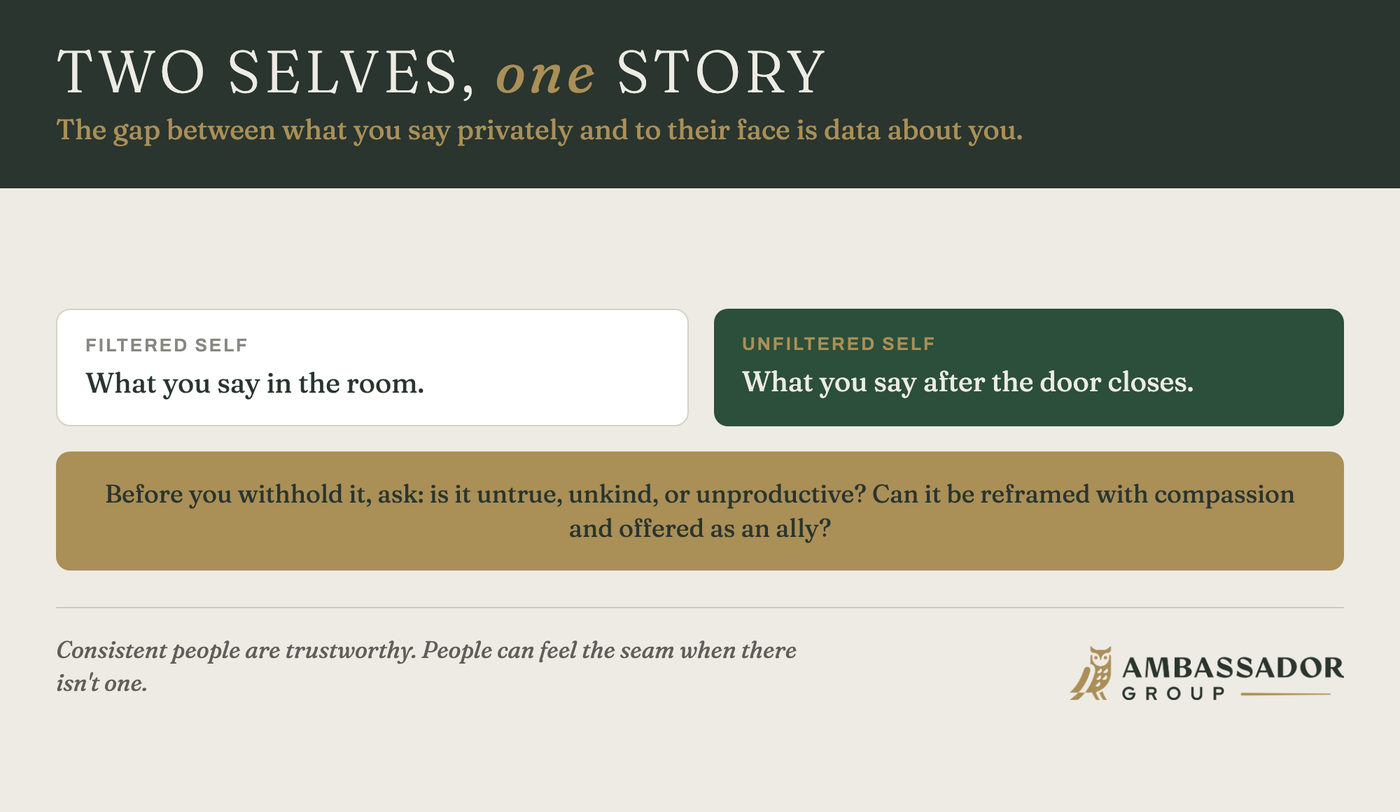
When there is a dichotomy between your filtered and unfiltered self, you are running two people. Two ways of thinking, two ways of speaking. One of them is more true than the other. The closer you pull them together, the more of your full self you can bring into a hard conversation. You can speak your mind with collaborative gentleness, advocate for your view without vitriol and without going soft.
Beliefs steer behavior in ways you do not consciously clock. If you hold a belief about a colleague that you never say out loud, that belief still leaks. It undermines the relationship from underneath. Limiting beliefs about a person limit your ability to work with that person, whether or not you ever speak them.
If you wouldn't say it to their face, don't say it.
That old line is the whole theme. So when you catch yourself withholding, interrogate it. Ask:
- Is it untrue?
- Is it unkind?
- Would it be unproductive?
- Can the complaint be reframed with more compassion and more optimism?
- Can I treat this as a chance to grow the relationship, and show up as an ally instead of a critic?
Set a standard of consistency between the story you tell yourself and the story you tell others about a conflict you are inside of. Holding yourself accountable to be explicit and charitable forces a more disciplined way to process the conflict. There is a healthy byproduct: you stop sliding into gossip and quiet undermining, because the story you tell yourself, the other party, and anyone adjacent is the same story, and a charitable one. Consistent people are trustworthy. People can feel the seam when there isn't one.
The emotional signal arrives first
To be clear, none of this is about suppressing what you feel. It is about understanding your emotions and reading them consistently, with enough training that they start handing you useful cues earlier. The signal often shows up before the intellectual case does. This happens in interviews constantly. Something registers as off before you can articulate why. The question is not whether you felt it. The question is what you do with it.
And when the case isn't built yet, be ready to tell yourself "I don't know enough" instead of inventing a private narrative about the other side's motives. Understand your own story first. Then ask sincere questions to understand theirs. No assumptions.
The gap between your two selves is the one variable here you fully control, and closing it is your work to do.