
How you treat the candidate you do not hire is the truest preview of how you will treat the one you do. The candidate sitting across from you knows this, even if you have never thought about it, because the way you run the process is the clearest signal you send about the way you run the company. Hiring is where a leader's respect for people becomes visible, and respect that only shows up after the offer is just convenience wearing a nicer name.
The industry trains you to see it the other way. The language alone gives it away: candidates as a pipeline to be filled, talent to be sourced, a deal to be closed. Every one of those words turns a person into a unit. And the moment a leader starts treating people as inventory, the best people feel it and quietly take themselves out of reach, because the ones with options always have somewhere else to be.
Candidates are not assets to be sourced and closed. They are leaders weighing their next decade, and treating them that way is both the honest thing and the strategic one.
What Inventory Thinking Feels Like From the Other Chair
Sit on the candidate's side for a moment. He is a project executive with fifteen years in, currently employed, quietly curious about whether something better exists. He is not a resume in a stack. He is a person making one of the largest decisions of his working life, weighing a move that touches his income, his family, his commute, his standing, and the next ten years of his career.
Now run him through a transactional process. He gets a rushed screen from someone who clearly did not read his background. He waits two weeks with no word. The role described in the first call quietly changes by the third. He is asked to rearrange his life for interviews that start late and end with no next step. None of it is hostile. It is just careless. And careless is its own message, received loud and clear: this is what working here will feel like.
He does not file a complaint. He just stops returning calls, and you never learn that the best candidate in your search left because of how the search itself felt.
The Table Runs Both Ways
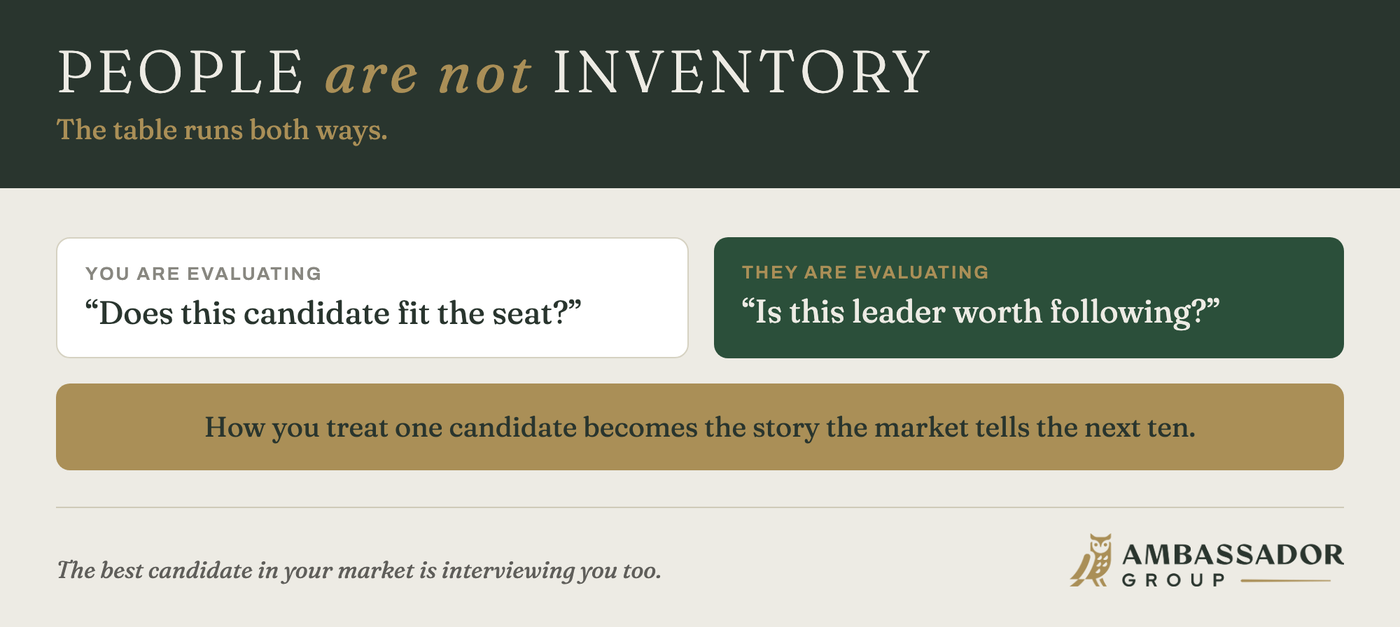
The reframe is simple and it changes everything. The interview is bilateral. While you are deciding whether the candidate fits the seat, the candidate is deciding whether you are someone worth following, and the stronger the candidate, the more carefully they are watching.
This is why the right question is not only whether the candidate fits the job. It is also whether the job fits the candidate, because a person who takes a role that does not actually fit them will leave, and a forced match is a slow-motion vacancy. The leaders worth hiring are running their own evaluation in parallel, scoring your clarity, your honesty, and your respect on the exact parts of the process you assume do not count.
The best candidate in your market is interviewing you too.
Dignity Is Also Strategy
None of this requires you to be charitable. It requires you to be accurate about where the power in this market actually sits.
The candidates you most want are scarce, employed, and not desperate. They have options. For those people, every careless thing your process does is a reason to choose one of the other options instead. Ghosting a finalist, letting a role drift into something the candidate never agreed to, springing a changed comp number at the offer: each of these costs you the exact people you were trying hardest to win. You do not lose the weak candidates this way. You lose the strong ones, because only the strong ones can afford to walk.
Treating people with dignity is how you win the ones who have a choice. There is nothing soft about it. It is a hard-nosed read of a thin market, where the people you need can afford to be selective and are watching to see whether you have earned them.
What It Looks Like in Practice
Respect in a search is not a feeling. It is a set of behaviors.
Tell the truth about the role, including the hard parts. The travel, the difficult client, the project that is behind. A candidate who takes the job knowing the real picture stays. A candidate sold a fantasy leaves the first time reality shows up, and now you are both worse off.
Represent both sides honestly. The candidate and the company each own the outcome of the relationship, which means the work is to serve both sides at once, not to win one at the expense of the other. A match made by hiding the truth from either party is not a match. It is a deferred separation.
Shape the role around the person where it is warranted. The strongest candidates rarely fit a job description exactly, because a job description is a static document and a person is a living, changing thing. Building the role around the person instead of forcing the person into the document is often the difference between a good hire and a great one.
Run the interview as a conversation, not a contest. The leader who treats the interview as a two-way conversation rather than a win-lose game gets more honesty out of the candidate and gives more in return, and the result is a decision both sides can actually trust.
Close the loop with everyone, including the people you pass on. A clear, respectful no costs you ten minutes and buys you a reputation. A silent ghost costs you nothing today and a great deal later.
It Compounds
The construction market is smaller than it looks. Supers talk to supers. PMs compare notes. Estimators move between firms and carry their stories with them. The way you treat one candidate does not stay between the two of you. It becomes part of how the market describes you, and that description either opens doors in your next search or quietly closes them before you knew they were there.
Two firms pass on the same project executive in the same month. The first lets him hear about it through silence, never returning the call after a final interview he rearranged his week for. He mentions it, without much heat, to three peers over the next quarter, and one of them is exactly the person the firm tries to recruit a year later, now pre-loaded with a reason to say no. The second firm gives him a straight, respectful no within two days, tells him honestly why the fit was not there, and points him toward a role that suited him better. He takes that call. Six months on, he sends that firm a superintendent he rates highly, because the way he was treated when the answer was no told him everything about what a yes would be worth. Same decision, opposite compounding.
Reputation is the compound interest on how you treat people, and transparency in how you run a search is how that interest accrues in your favor.
The full frame this sits inside lives on the Ambassador Group philosophy page.
Think about the last strong candidate you passed on. If you called them today and asked how the process felt from their side, what would they say. And would that answer help your next search, or quietly cost you the one after it.