
Every hire you make is a six-figure bet on future performance. The quality of that bet is not set by the candidate who walks through the door. It is set by the decision-maker who decides whether to let them in. That is your job. Not the recruiter's. Not HR's. Yours.
Most construction leaders run hiring the way they run sales: build rapport, create momentum, get to yes. The instincts that built your client relationships will produce your worst hires.
Sales optimizes for yes. Underwriting asks whether yes is the right answer. Conflating the two is the most expensive mistake in hiring.
The Frame That Is Hurting You
The language of hiring borrowed its vocabulary from sales a long time ago. You "close" a candidate. You "overcome objections." You "sell the opportunity." You build momentum and push for a decision before the candidate has time to think it over.
That vocabulary rewards the wrong things. Charisma, enthusiasm, and the performance of competence are easy to manufacture under pressure to impress. The candidate who is deliberate, who asks hard questions back, gets scored down for lack of excitement. The one who mirrors your energy and agrees with everything gets scored up.
A process built to manufacture a yes cannot tell you whether the yes is correct.
Picture the project manager search that felt easy. The candidate interviewed beautifully: firm handshake, war stories about saving a job that had gone sideways, quick to agree about how the team should run. Three weeks later the offer went out. Eleven months after that, the same leader was explaining to an owner why the schedule had slipped, why two superintendents had quietly started routing around the new PM, and why the seat was open again. Nothing in that interview tested whether the candidate could actually run the work. It tested whether he was pleasant to talk to. He was. That was never the question.
The recruiting-as-persuasion model has its own thorough defense, and reading why some treat recruiting as a persuasion process from start to finish alongside this essay sharpens the contrast.
Underwriting Means Pricing Risk
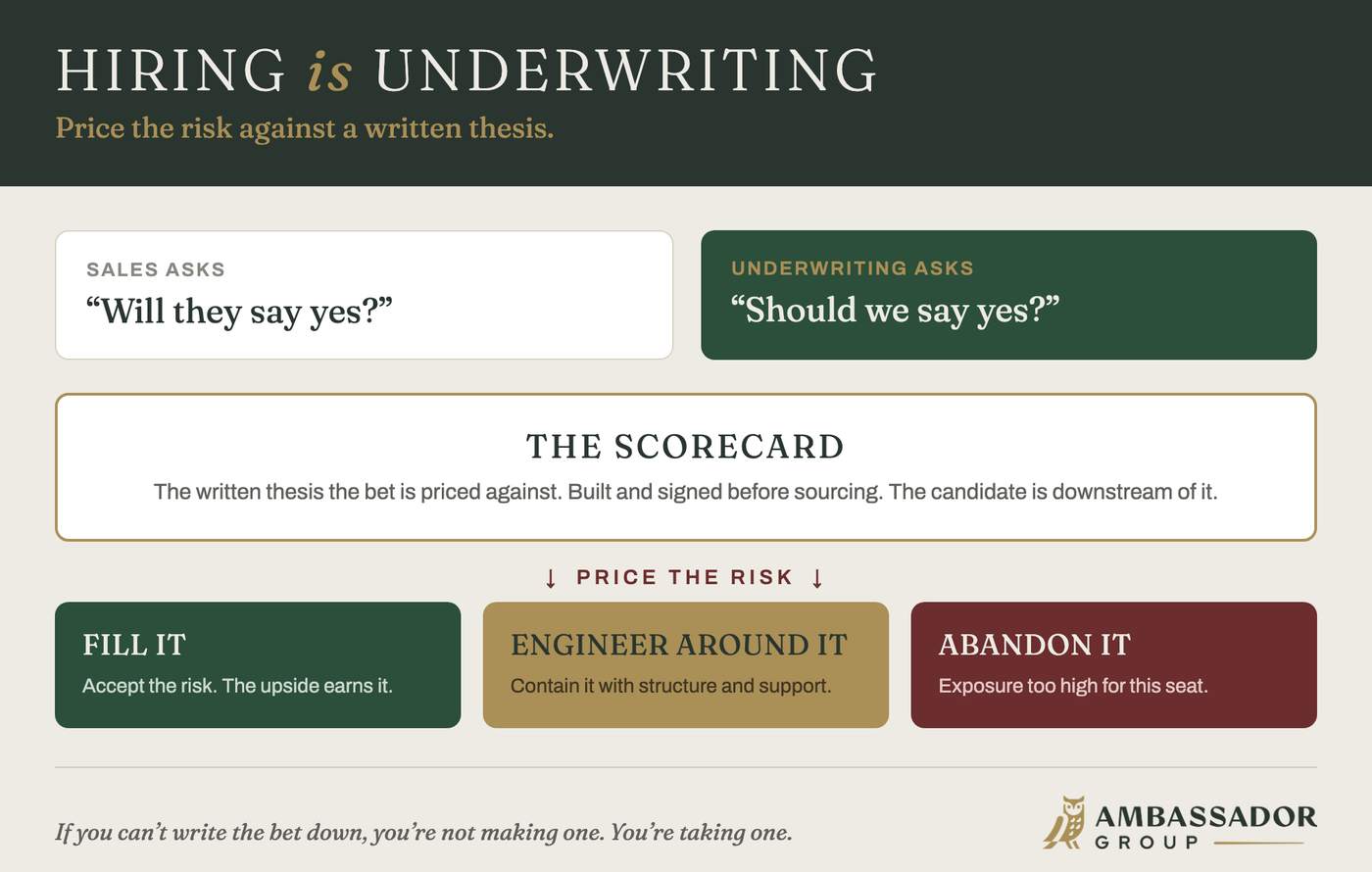
Underwriting runs on a different discipline. The underwriter prices the risk that the bet will pay off, then decides whether to take it.
Every person who sits across from you carries a risk profile: competency gaps, character signals, situational mismatches, growth constraints that together determine whether they can produce what the seat exists for, with these people, under this kind of pressure. Your work is to read that profile, price it honestly, and make a call you can defend. A decision, not a deal.
The candidate is downstream of the decision-maker.
The quality of a hire tracks the quality of the decision made about them: whether the hiring authority built a process capable of generating real evidence, asked the questions that exposed what matters, and held the discipline to walk away when the evidence pointed that way. That work sits entirely on your side of the table.
Pricing the risk does not mean eliminating it. No hire is risk-free, and waiting for the one that is becomes its own kind of failure. Once you have named the risk honestly, you have three moves: fill the seat and accept the risk because the upside earns it, engineer around the risk with structure and support, or abandon the bet because the exposure is too high for this seat at this moment. All three are legitimate decisions. What is not legitimate is leaving the risk unnamed, then discovering it at month eleven when it has already done its damage.
The Scorecard Is the Written Thesis
In financial underwriting, the criteria exist before the application arrives. Income ratios, collateral thresholds, default history. The loan gets measured against a standard written in advance, not a feeling assembled after the fact.
The scorecard is the hiring equivalent: the written thesis the bet is priced against, built before sourcing begins.
A scorecard worth the name answers four questions:
- What outcomes must this person produce in the first 30, 60, and 90 days, and across year one?
- Which competencies, developed and latent, are genuinely non-negotiable for those outcomes?
- What are the two or three deal-breakers that disqualify regardless of other strengths?
- What specific behavioral evidence, visible in history and in the interview, counts as proof for or against each competency?
One page. Signed by the decision-maker before sourcing begins, shared with every interviewer so the whole panel runs the same investigation.
Skip it, and the search has no thesis. Sourcing drifts toward "someone good." Interviewers measure candidates against private assumptions the panel never aligned on. The debrief becomes a collision of impressions. The final call rests on a feeling nobody can articulate or defend.
If you cannot write the bet down, you are not making one. You are taking one.
This is also why accountability breaks down so predictably when no written thesis exists: there is nothing to be accountable to.
Who Holds the Pen
The scorecard is not a recruiter deliverable.
A recruiter can facilitate the conversation that builds it, ask sharp questions, surface buried assumptions, and push back on criteria too vague to measure. But the hiring authority authors and signs it, because the scorecard describes the decision the hiring authority is prepared to defend.
That distinction carries weight. An HR-generated job description records what the company would like. A decision-maker's scorecard records what the decision-maker will require as evidence before writing an offer. Those are often very different documents, and only one of them underwrites anything.
This is why interviewers must own their hiring decisions as a genuine extension of their judgment. The scorecard gives that judgment somewhere to land.
The candidate sits downstream of all of it. A candidate can only respond to the quality of the process they are put through. No candidate can rescue a search that runs without a thesis.
What Changes When You Underwrite
Shift from sales mode to underwriting mode, and several things change.
The interview becomes an investigation. You are testing the thesis, not auditioning to like the candidate. You hunt for evidence that confirms the competencies and evidence that contradicts them with equal rigor. Likeability becomes a variable to manage rather than a signal to honor, because it reliably bends the data toward your existing preferences.
References become audit points rather than testimonials. A peer-to-peer reference, run by someone close to the decision, tests the specific claims the candidate made in the room. If he claimed he pulled a troubled hospital project back onto schedule, the call goes to the superintendent who stood in the trailer with him, not the HR coordinator who processed his exit paperwork. You are checking the footnotes, not collecting character witnesses.
The offer gets sized to the bet. Price the risk and you know what the bet is worth. An unwritten thesis produces one of two errors: underpayment, because you failed to recognize the caliber in front of you, or overpayment, because momentum carried you and you anchored high before the evidence landed.
Most important, you can say no with evidence. Not "it just didn't feel right." Not "they seemed great but something was off." Instead: "they did not demonstrate X, and X is a deal-breaker for this seat." That is a call you can stand behind, hand off cleanly, and learn from in the next search.
The Two Objections
Two objections come up every time.
First: top candidates need to be sold on the role. Courting a candidate and underwriting the decision are separate acts, and they do not interfere with each other. A well-run search is itself an expression of your culture. It signals that you take decisions seriously, that you respect the candidate's time, and that you require real evidence before you commit. The candidates worth having read that as a green flag.
Second: scorecards are bureaucracy. You write drawings before you break ground. You order a soil test before you pour a foundation. You would never commit to a six-figure build because the site looked about right and the conversation went well. The same leader who would never start a build without a scope has somehow normalized starting a search without one.
The scorecard is one page. It is the cheapest thing you buy all year when the match holds, and the most expensive thing you skipped when it falls apart at month eleven.
The full framework this essay sits inside lives on the Ambassador Group philosophy page.
Before your next search begins, finish this sentence: "We are betting that this person will ______ within twelve months." If you cannot finish it, the search is not ready to run.
The bet is yours to price.