
The seat is bleeding. A project is short a manager, the work is landing on the people you were trying to protect, and every week the hole stays open it costs you something real. So you move fast. And fast is exactly how the wrong person gets in.
This is not a patience lecture. The urgency is legitimate. What is worth seeing clearly is that the pressure which opened the seat is the same pressure that will fill it badly, and the decision about whether to let that pressure drive is yours alone. Hiring is where a leader's judgment becomes visible, and judgment under duress is the hardest kind to keep. The weeks you save on the search you pay back with interest over the eighteen months it takes to unwind a hire that never should have happened.
Speed is what makes the wrong hire feel right. It is the single most reliable distortion in the whole process, and almost nobody prices it correctly.
The Urgency Is Real
Start by granting what is true, because pretending the pressure is imaginary is how this advice gets ignored.
The seat is empty and the work does not pause for your search. Your best superintendent is covering two jobs. Your estimator is fielding calls that should go to a PM who does not exist yet. The people you most want to keep are the ones absorbing the overflow, and every week you take to hire well is a week you spend that goodwill. The cost of an open seat is real, it is visible, and it lands on exactly the people you cannot afford to burn out.
That cost is what makes the fast hire feel responsible. You are not being reckless, you tell yourself. You are stopping the bleeding.
The Trap
Watch what speed actually does. It does not just move the process faster. It silences the part of you that would have saved you.
Every rushed search has a moment where a small doubt surfaces. The references were a little thin. The candidate dodged one question and you let it slide. Something about how he talked over your foreman in the site walk sat wrong. Under normal conditions you would pull that thread. Under pressure, you reframe the doubt as perfectionism and move on, because the alternative is another three weeks with the seat open, and you cannot stomach three more weeks.
The cruelty of it is that haste disguises itself as decisiveness. Moving fast feels like leadership. It looks like leadership to the team watching. And it produces the worst hires you will ever make, because the doubts you skipped were the most valuable data in the entire search. They were your judgment trying to reach you, and speed is what kept the line busy.
What the Fast Hire Actually Costs
The bill comes later, and it is larger than the weeks you saved.
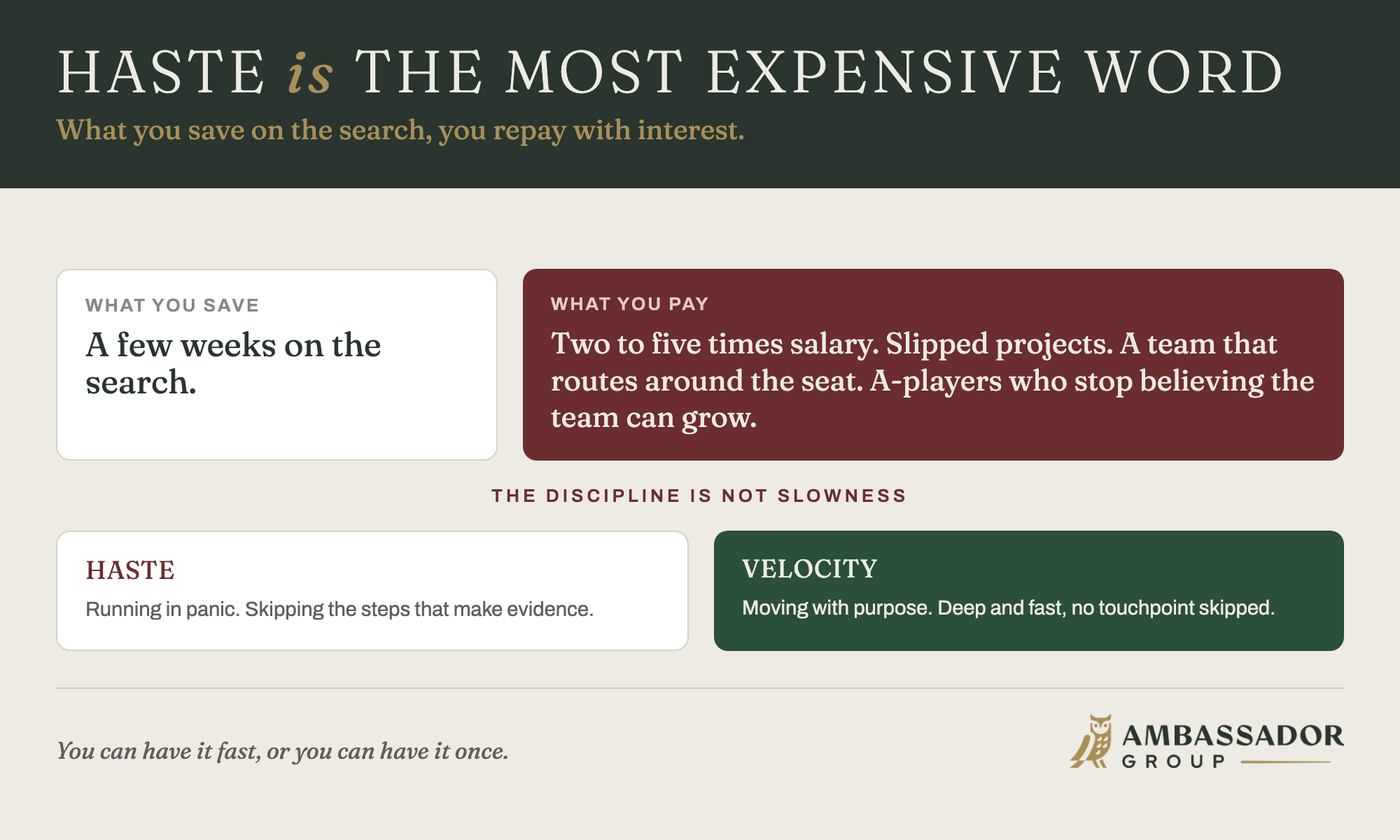
There is the direct replacement cost, which for a manager runs somewhere between two and five times base salary by the time you count severance, the second search, lost ramp time, and the months the seat sat half-filled. That number alone dwarfs the few weeks you saved by skipping a reference call or a second interview.
Then there are the costs that never show up on a spreadsheet. The projects that slipped while the wrong PM learned he was in over his head. The two superintendents who quietly started routing around him because they could not trust the work. The trust you spent with your A-players, who watched you hire in a hurry, watched it fail, and drew the obvious conclusion: that this team cannot grow reliably, and maybe their own future here is shakier than they thought. That last one is the most expensive line on the page, because it is how a single rushed hire starts costing you the people you never wanted to lose.
Watch how it actually unfolds. You sign the project manager in record time and feel the relief of a closed seat. By day thirty the relief is gone, because the work is not getting managed and you are quietly doing parts of it yourself. By day sixty your best superintendent has stopped bringing problems to the new PM and started bringing them to you, which means you now have the seat's work plus the seat's salary. By month four you are documenting performance, by month seven you are paying severance, and by month eight you are back where you started, except the hole is deeper, the team is more tired, and the search you would not give six weeks now has to happen anyway. The fast hire did not save you the search. It charged you the search twice and added a year of damage in between.
Aviation has a name for the place where this happens. Coffin Corner is the altitude where flying too slow and flying too fast are both fatal, and the margin between them collapses to nothing. Hiring under duress puts you there. You feel too busy not to hire and too busy to do it right, and both errors are lethal in different ways.
Discipline Is Not Slowness
The fix is easy to mishear. Nobody is telling you to go slow. A search that drifts for four months while you wait for perfect is its own failure, and it burns your team exactly the way the rushed hire does.
The distinction that matters is between haste and velocity. Haste is running in a panic, skipping the steps that generate evidence because you cannot tolerate the wait. Velocity is moving with purpose, keeping real pace, and refusing to skip the touchpoints that actually tell you something. You can interview deep and fast at the same time. What you cannot do is interview shallow and call the speed a virtue. Shortcuts are where the costly mistakes live, and a rushed interview is a shortcut wearing a deadline as a disguise.
You can have it fast, or you can have it once.
How to Push Back on Your Own Urgency
Two habits keep the pressure from driving.
Pre-commit to the process before the pressure hits. Decide, while you are calm, what your search will always include: the number of interviews, the reference depth, the people who must weigh in. Write it down. A standard set in advance is the only thing that holds when the seat is bleeding and every instinct says to cut a corner, because in the moment you will not have the clarity to decide well. Borrow it from the version of you who did.
Separate stopping the bleeding from filling the seat. They are two different problems, and conflating them is what forces the bad hire. A contractor, a temporary reassignment, an overtime stretch with a clear end date: a stopgap buys you the room to run the real search without panic. A stopgap is not a hire, and treating it as one is how the urgent crowds out the important. Stop the bleeding one way, and underwrite the seat the other way, on the timeline a permanent decision actually deserves.
The full frame this sits inside lives on the Ambassador Group philosophy page.
Before you sign the next fast offer, put two numbers next to each other. What does the empty seat cost you per month, honestly counted. And what did the last wrong hire cost you in total, honestly counted. Then decide which number you are actually afraid of, and whether speed is solving the smaller one at the price of the larger.