
You did not finish hiring when the candidate signed. You barely started. The signature closes the search, but it opens the part of the process that determines whether the hire works, and most leaders treat it as the finish line and walk away. Hiring is where a leader's ownership of an outcome is tested, and the test does not end at the offer. It begins there.
The mistake hides inside a word. Fit gets talked about as though it were a property a candidate either has or lacks, something you screen for across a few interviews and then check off. Screen hard enough, the thinking goes, and the right fit walks in pre-assembled. But fit is not a fixed trait you detect. It is a relationship two sides build and tend, and like any relationship it is made or broken not at the introduction but in the early days of actually living it.
Day one is the start of that work, not the end of it. The offer is the start line.
The Myth of Fit as a Fixed Trait
The screening model of fit is seductive because it puts all the work before the offer, where it feels controllable. Run a good process, read the signals right, pick the person who fits, and the rest takes care of itself. Fit becomes something you possess by the time you sign.
The model fails because it treats a living relationship as a static measurement. You can confirm in interviews that a candidate is capable, aligned in values, and plausibly suited to the seat. What you cannot confirm is that the fit will hold once the person is inside the actual texture of your company: your pace, your politics, your particular way of running a job. Fit is provisional at the offer. It gets proven, or lost, in contact with reality.
The Truth Is Bilateral
Fit runs in both directions, and that is the part the screening model misses entirely.
You are not only assessing whether the candidate fits the role. The candidate is assessing, every day of those first months, whether you and the company fit the future they signed up for. The leader has to fit the new hire as much as the new hire has to fit the leader, and both sides have to keep choosing the match after the ink is dry. A hire who concludes in week six that the job is not what was described will start leaving long before they resign, and no amount of screening rigor at the front end prevents it if the landing is neglected.
This is why fit cannot be finished in the interview. It is a thing both parties keep building, and the leader owns their half of the construction.
Most Hires Fail at the Landing, Not the Pick
The numbers point somewhere uncomfortable. When a hire goes wrong, it usually goes wrong inside the first year, often inside the first ninety days, and most often for reasons that had nothing to do with whether the person could do the work.
They could do the work. What went missing was alignment. Nobody told them what winning looked like in the first month. The priorities they were handed contradicted each other. The leader who recruited them so attentively went quiet the day they started and reappeared only to deliver a correction. The new hire was left to assemble the job from fragments, guessed wrong on a few that mattered, and was judged for the guesses. None of that is a hiring miss. It is a landing miss, and it gets misdiagnosed as a hiring miss, which means the leader learns the wrong lesson and tightens the screening that was never the problem.
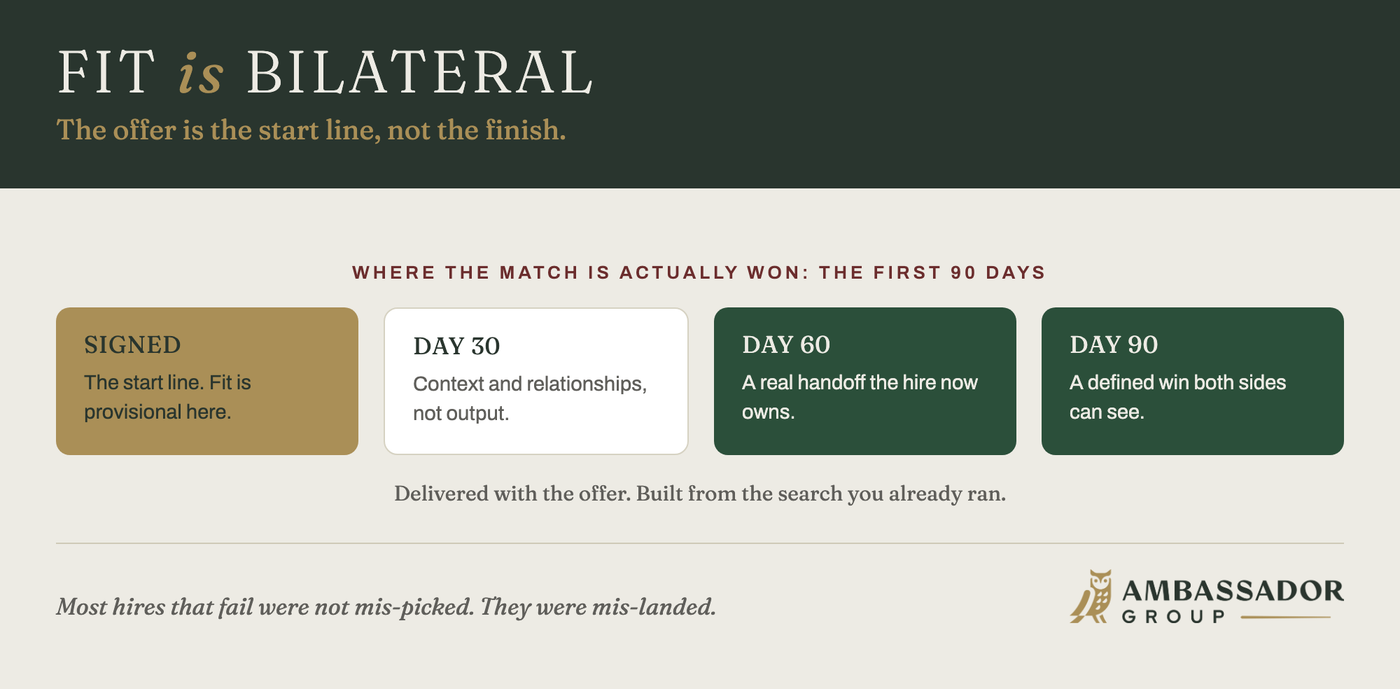
Most hires that fail were not mis-picked. They were mis-landed.
The Instrument Is a Landing Plan
The fix is concrete: a ninety-day landing plan, delivered with the offer, built from the data the search already produced.
You spent weeks learning this person's strengths, gaps, and motivations. That knowledge usually evaporates the moment the offer is signed, when it should become the blueprint for the first ninety days. A landing plan names what the first thirty, sixty, and ninety days are meant to produce. It sequences the introductions, the context, and the early wins. It turns the abstract hope of fit into a set of outcomes someone is actually responsible for delivering, so onboarding does not drift into the vague "watch and learn" that sinks good people.
Make it concrete for a new project manager. The first thirty days are for context, not output: meet the supers and the key trades, walk every active job, learn how this company actually runs a buyout and a change order, and build the relationships the role depends on before anyone grades the work. By sixty days the plan names a real handoff, a project or a scope the PM now owns outright, with the leader close enough to catch a fall but far enough back that it is genuinely theirs. By ninety days there is a defined win, something concrete enough that both sides can look at it and agree the landing worked. Written down and handed over with the offer, that sequence replaces the vague "watch and learn" that quietly drowns good people in their first quarter.
This is the Finish in Find, Filter, Fit, Finish, and it is the phase most companies do not run at all. The search ends at Fit, the offer goes out, and Finish is left to chance. A plan is what closes that gap, and it works because it converts a feeling into a structure. Good onboarding sets guardrails that keep a new hire on track without replacing the leader's role in their development.
Alignment Is a Practice, Not an Event
Even a strong landing plan is not a one-time act. Alignment drifts the way any relationship drifts when nobody tends it, and the best initial match degrades without maintenance.
Onboarding never ends, because alignment never ends. The leader who checks in at thirty days and then disappears for a year has not onboarded anyone. He has deferred the drift. The work is ongoing: recalibrating as the role changes, surfacing the small misalignments while they are still small, and keeping the two-way fit honest as both the person and the company keep moving. This is continuous development, and it is the leader's job, not the new hire's. A new hire cannot align themselves to a target only the leader can see.
That ongoing tending is also the quiet engine of retention. People stay where they are still growing, still aligned, still chosen. The ingredients of retention are mostly just fit, cultivated past the offer instead of assumed at it. The leader who tends the match keeps the person he already paid to find. The leader who assumes it pays to find them again, and again, and calls the churn a market problem when it was a maintenance problem all along.
The full frame this sits inside lives on the Ambassador Group philosophy page.
Think about your last hire's first ninety days. What were they actually designed to produce, and who owned that design. If the honest answer is that nobody did, you have found the place where your next hire will be won or lost.