
A hire failed, and the easiest story to tell is that the candidate was the problem. They lacked the skill, the character, the perspective the role demanded. Write the failure off to them, and you are free of blame. You are also guaranteed to repeat the mistake. The quality of a hire is principally driven by the leader, not the candidate, and a failed hire is the clearest mirror a leader ever gets. The recruiting industry sells the idea that better candidates are the lever. They are not. Your willingness to look at your own part in the failure is.
"We do not learn from experience... we learn from reflecting on experience." (John Dewey)
Great companies do not make the same mistake on a loop. If you actually believe your people are your greatest asset, a failed hire is a serious event, and the lesson inside it is too expensive to throw away.
Run the math on what that lesson is worth. A company that turns over one hire in four is operating in a different universe than a competitor turning over one in two. That gap is energy: hours and attention that go toward winning work and sharpening the product instead of rehiring the same seat. Teams that build well grow at a healthier, more sustainable level of stress. A fast learning pace is the whole game.
Clear the excuses first
The unproductive version of this conversation always sounds the same:
- "They didn't tell us about that in the interview."
- "Their performance was lackluster."
- "They needed too much hand-holding."
- "They didn't fit our culture."
- "They just didn't do the job."
Every one of these hands ownership to the person who already left, which is exactly why the next hire fails the same way. The harder question is the useful one: when a teammate failed, where did the team fail the teammate? Communication. Training. Encouragement. Accountability. Start there.
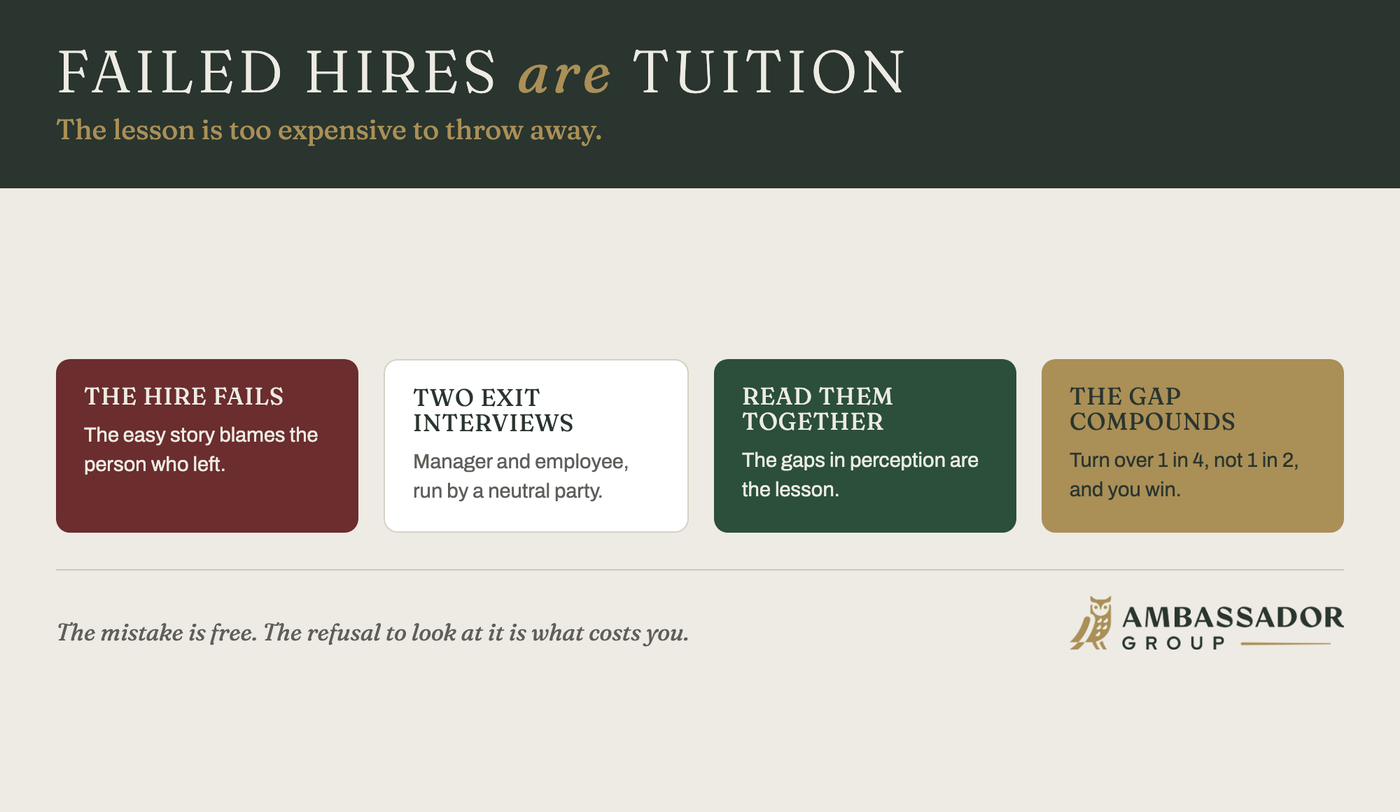
How to extract actionable insight
Run separate exit interviews with the manager and the employee, conducted by a neutral party. Internal or external both work, as long as the party has no stake in the verdict. A matchmaker who sits outside the relationship can do this for you for a nominal charge if that is useful.
Then review the two interviews sequentially, asking the same questions of each, so the differences in perception surface cleanly. When a manager knows the exit interview will be read against the employee's account, that alone changes how honestly they show up. Accountability without blame is a healthy pressure, not a punitive one.
Some cultures cannot run this, because of how they process failure: as something toxic and shameful. The cultures that treat failure as raw material for growth, and reward the person willing to own their part of it, are the ones this pays off for. Even when a candidate lied outright, there is a lesson sitting there about how the team validates what it is told.
This is hard to talk about openly
It is emotional, and the truth has more than one side. A few forces work against honesty in the room:
- Everyone has a psychological interest in being blameless.
- Blaming the person who is gone is easier and feels safer.
- You do not know what you do not know.
The failure usually lives in one of three places: culture fit, job performance, or mismanagement. Name which one before you start assigning it.
Run the conversation well
A few things hold the room together:
- Ask "what" questions, not "why" questions. "Why" puts people on defense. "What did we learn? What will we do differently?" keeps the room looking forward.
- Expect disagreement and use it. Different vantage points are how you assemble the fuller picture of what actually happened. Apply judgment to pull the usable insight out of the noise.
- If you lead, go first. Name what you would do differently before anyone else has to. The vulnerable parties need to feel trust and psychological safety before they will tell you anything real. No witch hunts.
Whatever the team got wrong, you own a share of it as the leader. That is not a posture. It is the fact of the role.
Questions to put to yourselves
- What did we fail to understand in the interview?
- What expectations did we set without ever confirming mutual understanding? Saying an expectation out loud is not the same as landing it.
- What skills did we never actually validate? Asking about a skill is not the same as watching it show up in a behavioral answer or a sample problem.
- How could our culture and our expectations have been made clearer up front?
I have sat inside companies of every kind, and the pattern is consistent: the ones that diagnose their hiring failures quickly, cheerfully, and without flinching build a durable competitive advantage their rivals never see. The mistake is free. The refusal to look at it is what costs you.
The next failed hire is going to hand you the same mirror. Whether you look into it is the only variable you control.