
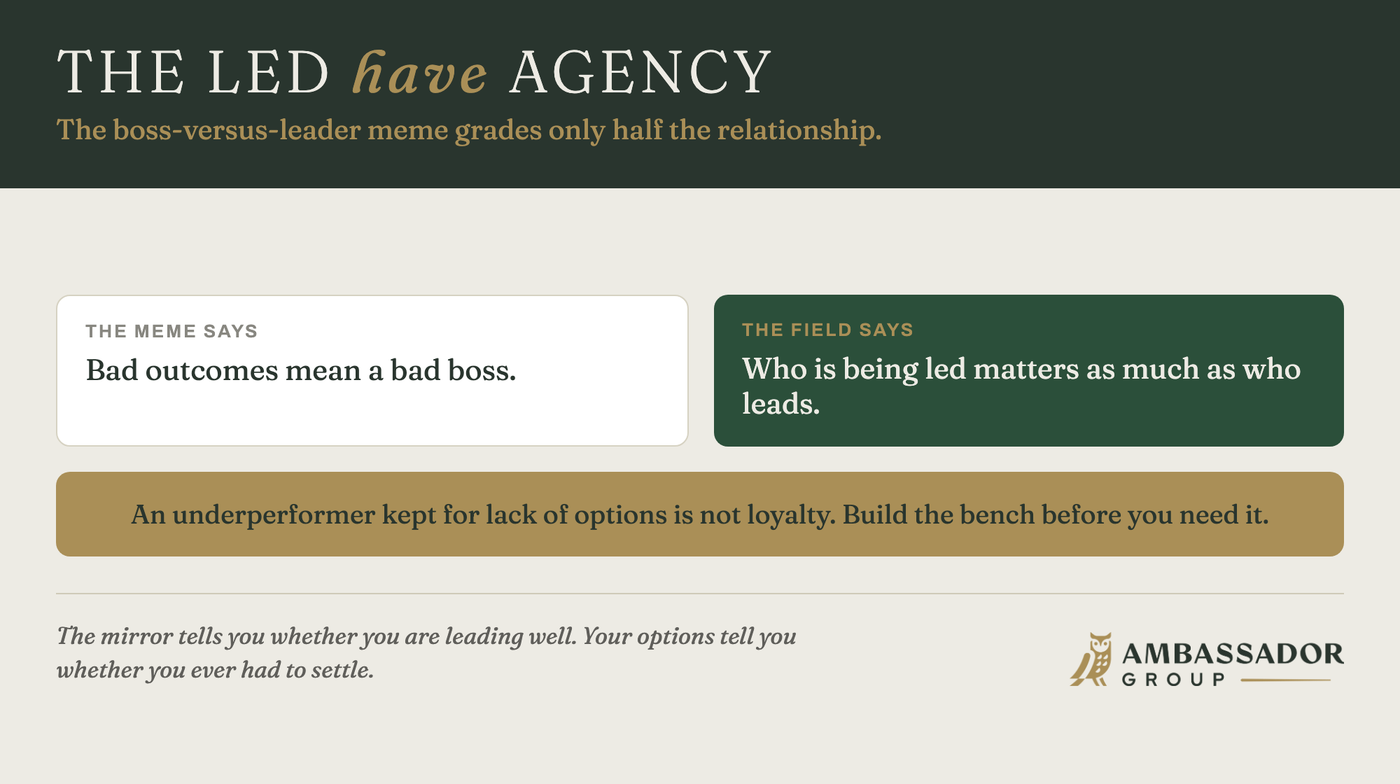
The boss-versus-leader meme has become a genre. Scroll long enough and you will find the same cartoon: the boss barks orders from behind a desk while the leader pulls a rope at the front of the line. It is tidy, it flatters the reader, and it quietly lies about where hiring quality actually comes from. The quality of a team is principally driven by the leader, and a leader's read on the people in front of them rises with their self-awareness. But the popular version of this idea skips a variable that decides the whole outcome: the people being led have agency too, and pretending they do not is its own failure of leadership.
Some of these posts go further and imply that leadership can be pure positive reinforcement, accountability sanded off, conflict avoided. That is a comforting fiction. Leaders should lead from the front, whatever the front means for them. And there is something quietly dystopian in the memes that cast every employee as a victim of their manager. That frame does not build good working relationships. It builds resentment with a halo on it.
The standard setup pits top-down, heavy-handed management against relational, inspirational leadership. LinkedIn loves the binary because it renders cleanly. Real management does not render cleanly. It is human to human, and it is multifaceted in a way that is unique to each person you are responsible for.
As with every stereotype, the dichotomy holds a grain of truth. A manager who does not care about people is not a good manager. A leader who takes all the credit is selfish and insecure. Morale failures are not a sign of good leadership. Those things are true even when stated simply.
The variable nobody talks about
Here is what the genre leaves out. Almost all of this leadership-effectiveness talk evaluates the leader as if leadership happened in a vacuum. It does not. Judging a leader without weighing who they are leading is like grading a Mont Blanc on how well it writes on tissue paper. The result will always look bad, and the pen was never the problem. The medium matters. The people being led matter a great deal.
Some people will not be inspired. Some will not be gently led. Some are stubborn, proud, and genuinely difficult. A person can be a high performer in one slice of the job and incorrigible everywhere else. So what do you do? How do you inspire someone who cannot be bothered to take their own career seriously? At some point you are looking at issues more fundamental than a boss can responsibly invest in fixing. Where that line sits is a judgment each leader has to make.
This is the stage where leadership stops resembling cooperation and starts resembling a chess match. Aligning a resistant person with the organization becomes a campaign of pressure rather than partnership. It is painful work. Pounding a square peg into a round hole tends to damage both the peg and the hand holding the hammer.
Why leaders bear with people they should let go
The clean answer is to let those people go. But in a market where finding a replacement, never mind one with the right attitude, is hard, leaders stall. They bear with it. And it is worth naming what is actually happening when they do: that person is keeping their job because of the leader's lack of options, not because of their performance.
So develop options. That is the whole motive behind building a real network to hire from before you need it. A deep bench is a guard against being held hostage by an underperformer. The leaders who get taken advantage of are almost always the ones with nowhere else to turn.
A failure to hold underperformers accountable, and to part ways with the ones who refuse to change, will be exploited indefinitely.
I see a lot of leaders being taken advantage of by people who simply refuse to care about the work. That is one of the real engines behind hiring demand: find the people who care. And those same leaders tend to blame themselves nobly for the wrong problem. Work leadership cannot solve every fundamental issue a person carries from their personal life into the office. Sometimes it can. Often it cannot. Judge wisely. When you finally hire people who care, leading them with care turns out to be almost effortless.
Do not misread me. I am a fan of compassionate leadership and I have no patience for cruel management. I am only insisting that the people being led hold a large share of the outcome. The cleanest version of the distinction still stands: leadership is about influencing people to follow, management is about maintaining the systems and processes. Both are real. Neither one excuses you from the harder judgment about who belongs on the team in the first place.
The mirror tells you whether you are leading well. Your options tell you whether you ever had to settle.